Friday, July 21, 2006

The Maker of the Soul

shoes

I'm grateful I've lived to see Lynda Barry sing Emily Dickinson's poem, "The Loneliness One Dare Not Sound," a stanza here:

I fear me this -- is Loneliness --
The Maker of the soul
Its Caverns and its Corridors
Illuminate -- or seal --

And if you're thinking Yellow Rose of Texas, you're way off. She set it to the classic Brazilian tune, Girl From Impanema. It was one of the main "images" I took away from her class, Writing the Unthinkable, at the Omega Institute upstate. Writing is a lonely business, one that "causes swelling," in Barry's words, and it's something we practice for our own mental health. Publishing, fame, all that stuff is secondary, and in fact a recent development. Writing has gone on for ages, and words do find ears, or not, and maybe that's not the point. She also recited daily Rumi's poem, The Diver's Clothes Lying Empty on the Beach, which grew in nuance with every recitation. Both Rumi and Dickinson gave work to the world like "seeds," or "spaceships" (Barry's terms), without the problematic goal of publication. And for every Dickinson, she argues, there are thousands we don't know about.

The goal of the class was exploring writing as a form of solitary "play," the kind that nourishes. To bring home the solitude of writing practice, she kept the class totally anonymous, avoiding the primate instinct to establish hierarchy. (She says that monkeys will give up their food for two things: pictures of monkey genitals, and pictures of the top monkeys.) Feedback on our writing was not allowed. Chitchat in the classroom was not allowed. It was not a social occasion. There were maybe 60 people in the class, and I didn't try to make friends with anyone new. And she gave us, or rented us, her teacher persona as an "image," uniform and all, to take home with us. She wasn't there to be our friend, or even our mentor. She was there to share with us her own working toolbox, to help us explore our own memories, and to offer us new memories to take home.

The focus of the class was what she calls "images," which are detailed slices of memory, the seeds, the resonances, concrete moments in time. We did a lot of list-making, then chose items from lists (or let the items choose us), then written response to her questions to bring the images into clearer focus, then timed freewriting. After the freewriting, we were not to reread our work unless we volunteered to read aloud. Then, while volunteers read, we all doodled spirals and focused on our own drawings, like we were listening to a radio show. This process kept the readings anonymous, and encouraged shy people to read, as if they were reading to themselves. Even she didn't look at the readers: she kneeled before us, looking at our bare feet. After each reading, her only response was a heartfelt "good," with a look in the eye.

Eventually, we moved into fiction, using magazine photos instead of memories as prompts. And after the work we had done with our own lives, the responses to the photos were poignantly vivid and concrete, and evoked real empathy. You could feel it in the room.

This system had several results. One is we not only had access to our own images, but a wealth of images from the anonymous throng. Another is that we were encouraged to turn off our own inner editors, in the absence of specialness and "success." And we were freed to access hidden pockets of our own memories--maybe doodling the spirals helped too--which we can choose to use later, or not.

The toolbox is one I will turn to again. I highly recommend her class for writers at all levels. And for other creative people too, especially introverts, who want to feel awake and alive through this kind of practice. It's a good system for breaking through writer's blocks, and for rediscovering the reason we all do this. It's not for recognition. The thing that moved the class participants was the work itself, the process of contemplation, and the permission to do it, warts and all. The warts were the most beautiful parts.

A few more things I will try to practice going forward. Memorize other people's poems. Recite them over and over to discover what is there. Work in series. Journal in lists of images from the previous day. Grab nouns from the lists and use them as timed writing prompts. Use two timers for freewriting: one to tell me it's time to find the ending, another to say stop. And remember why I'm doing this: it's a daily practice I enjoy. I'm doing this to learn and feel things.

The writing class was one of three classes I attended daily there. Before breakfast, I took an optional yoga class, part flow, part Kundalini breathing practice. Before dinner, I did meditation, led by a Zen practitioner, which was 15 minutes of silent sitting, 15 minutes of slow, present walking, 15 minutes of contemplating specific compassionate ideas, and some chanting. I'm on the fence on chanting, but I did it anyway. It's weird to sing words I don't understand. But I did it, because I didn't want to ruin the experience for the person seated next to me.

The combination of the three daily practices: yoga, writing, and meditation, encouraged me to let go of the judgment I carry. Barry argues that we edit all the time, citing her walk across the Omega campus: "beautiful flower, beautiful flower, hate that birdhouse." I'm paraphrasing, but you get the gist. Lynda Barry's class in particular encouraged me not to judge.

Then, like clockwork, the rest of the hippy-dippy arts week confronted me with the exact thing I LOVE to judge: new age mumbo-jumbo, let's all be free and happy, blah blah blah. It was a nice balance, because Barry's class took us into difficult places--the goal was not happiness there, and anger was allowed. But because of her anti-hierarchy approach, I was gentler with myself, and gentler with these other human beings, many of whom were trying to heal themselves from great physical and psychological suffering.

So, it didn't kill me to chant a little in languages I don't know. Plus, singing feels good. It feels so good that I even took a sampler class for Sister Alice Martin's Gospel Community, and sang along with everyone else, some of whom were moved to dance. If you know me, you know that hymn-singing is a sensitive area for me. I've left the church, and anything churchy can be traumatic. But I let myself enjoy the happy contagion. I let it be the same as the chanting. It just feels good to let the voice out, and to feel the larger voice around me.

Lots of tears, lots of laughs, lots of contemplation, lots of vegetarian food, and I do feel more open-minded as a result. Now, back to the real world. I hope I can keep some of this with me. I have more photos too, maybe I'll dump them into a new post.

Monday, July 17, 2006

My Granola-Eating Week So Far


Well, it's only Monday of my week-long stay at the Omega Institute, but I've learned stuff anyway. Like:

1. Baby rabbits are cute as hell.

2. So are baby fish, especially when they swim around your feet.

3. If you get up at 5 AM you see more of the above.

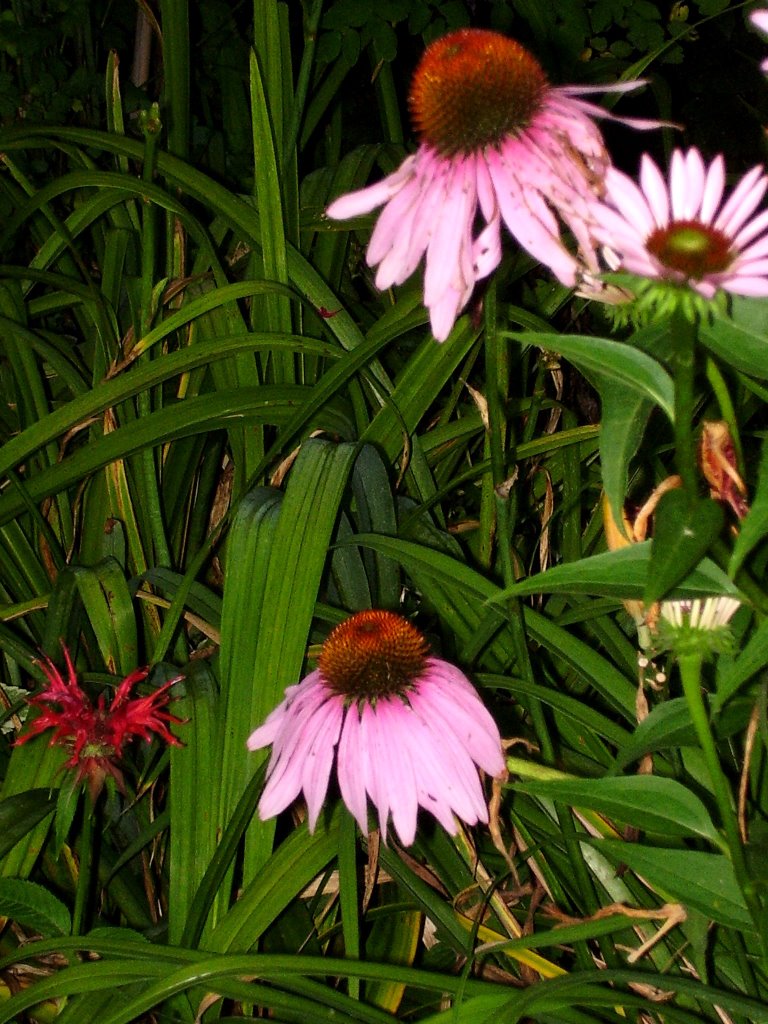
4. I have to try growing Echinacea (see picture). Such audacious blooms, sticking out their tongues as you walk by.

5. If everyone leaves their shoes at the door, there are NEVER any two pairs alike. At least I haven't seen any. Shoe diversity is good.

6. I'm not as inflexible as I thought, though I am still totally uncoordinated. Sometimes I can't tell my left leg from my right arm. I'm trying to roll with it.

7. Lynda Barry exceeds expectations. It's part stand-up, part writing class, all aimed at working with images. More on this later (maybe). Good so far.

Friday, July 14, 2006

Dave King Tells All on Bat Segundo Show


If, like me, you're a fan of Dave King's wonderful debut novel, THE HA-HA, then pop on over to the Bat Segundo show and hear King divulge some of his trade secrets to Ed Champion. It's a true peek under the hood. You get to hear about the iambic pentameter version of the novel, as well as the ending that struck early readers dumb...(he's since changed it). You also hear about the care he took to keep the tone light, almost informational, to avoid turning this super-dramatic subject matter into movie-of-the-week treacle. King is articulate, humble but not insecure, and really seems to have both feet on the ground. It's also nice for me to hear about another writer who started out as a visual artist. A true role model for us fiction beginners, and a very entertaining and educational podcast.

Thursday, July 13, 2006

More Vicarious Living...This Time Misty Oregon

In case you're wondering what happens at the Tin House summer workshops, check out Stephanie Anagnoson's blog. She's getting some face time with online friends, experiencing the notorious Pacific Northwest "wet air," enjoying a very supportive (and non-Iowa-model) workshop with Jim Shepard, and falling behind on sleep, which I've heard is an issue at these summer things.

Sounds like Tin House is giving Bread Loaf a run for its money. Will it be the new envied summer destination? Is it already? I think I'll apply next year. Maybe I'll apply to all of them...improve my odds a little.

Meanwhile, I have my own summer destination looming. I'm off to art camp this Sunday at the Omega Institute, for a week of yoga, canoeing, meditation, garden-walking, and a generative class called Writing the Unthinkable, taught by the incomparable Lynda Barry. I hope it's what the doctor ordered. I have my loose leaf notebook ready.

Wednesday, July 12, 2006

Getting Out of the Way

Well, folks, I'm chipping away at Novel #1 again, to see if it's a sow's ear or what. The theme of this revision is simple: Get the hell out of the way.

Taking stock, trying to be honest and not fake-humble: I'm okay with building characters, maybe even good at it. And sure, the characters have plausible feelings about each other. And okay, I'm starting to get the hang of my voice. But I have a major weakness--plot.

At least that's how I feel about it today. The story lacks clarity of conflict and/or quest. Readers like the protag, maybe even love her. But they want to fall in love with the story too.

So here's the experiment--assume the weaknesses of plot are all due to the Grand Design I imposed on the project way back in the planning stages. Let go of the plan. Let go of the Rashomon storytelling conceit. No external maps allowed.

I started out about ten (ach! embarrassing!) years ago, thinking I would write a metaphor-driven novel. Readers' response: "I see it has these sustained/recurring themes. But what's it about?"

Not being a plot person, I then set out to turn it into a character-driven novel. Reader response: "These characters are cool. But what's it about?"

So I go back to the manuscript, thinking maybe if the prose was cleaner, the message would be clearer. Trimmed a lot of fat. Reader response: "Nice prose. What's it about?"

Hmmm. All these comments are flattering and encouraging, but also confusing. What, exactly, does that question mean?

My interpretation-of-the-day: these readers are not looking for morals-of-the-story. They want to go for a ride. The work I've already done will help in this capacity, but it may not be enough. And the new shape has to come from inside the story. Sure, I wrote it, but now it's time for me to shut up and listen. Get out of the way of the story that's already there.

I tire easily of discussions on crafting plot. "Raise the stakes!" "Beginning-middle-end!" "It needs an arc!" "Put your characters in real jeopardy!" Maybe this is why I've resisted the notion of plot itself--it feels too much like a screenwriting class rehash. Parroting mottoes, without questioning the authority we've bestowed upon them. It's too gimmicky. It's too formulaic. It makes me grumpy.

But this new (to me) approach, maybe I'll be able to forget what I'm after and find what readers are after. Get out of the way, don't hide the story with language and fluff, don't try to be clever, and don't blindly conform to the Freitag Triangle master plan either. Ask questions instead. Like: why is this night different from other nights? Why now, this character epiphany? What conflagration triggered it? Then, maybe, the characters will drive the bus, and the readers will be more willing to hop on for the duration.

Plus, it will be way, way shorter. That never hurts, when you're pitching a first novel. The thick ones get read last, I've been told.

Monday, July 10, 2006

My First Fiction Review Ever!

Matt Bell is reviewing all the material in Hobart 6, including my piece, "Three Lessons in Firesurfing." I couldn't be more stoked. It's the kind of review we live for:

Sara's obsessed with both the known quantities of personal items and in the covering up of what is personal. Later, as she rediscovers these objects, she finds them changed by her actions, which has made them both functionally useless and artistically alive at the same time. By being hidden and then uncovered, they become something else completely, requiring new modes of thinking about them. This change is also reflected nicely in the ensemble of characters that inhabit the story.

Part of almost all coming-of-age stories is the recognition that the other characters are just as confused and scared as the narrator, and that by recognizing this quality in others the narrator can learn to deal with it in herself.

That seems to be my theme, or maybe my broken record, but regardless, it feels great to get it across. Read the rest of the review here.

Friday, July 07, 2006

The Future of Small Press?

Soft Skull Press going in the subscription direction, forging a whole new business model (or reprising an old one?) for small presses. For $100, you can do a fiction subscription, and receive all the 2006 fiction offerings plus a couple bonus titles.

Makes perfect sense to me, for a press with its own identity. Does the logo on the spine make you want to buy a book? For some of the small literary presses, the answer is an emphatic yes. Kudos to Richard Nash for giving this idea a go.

Come Surf This Mag Wave With Me

Clifford Garstang is blogging about litmags, and they're not the usual pack. His reviews are thorough and insightful, helpful for both reading fans and potential submitters. A good resource.

Things I Have in Common With Vladimir Putin

1. We were both born on October 7. You astrologists can figure that out.

2. We both know how to say "Tell me please, where is Red Square?" in Russian. (This greatly amuses my Russian colleagues at work.)

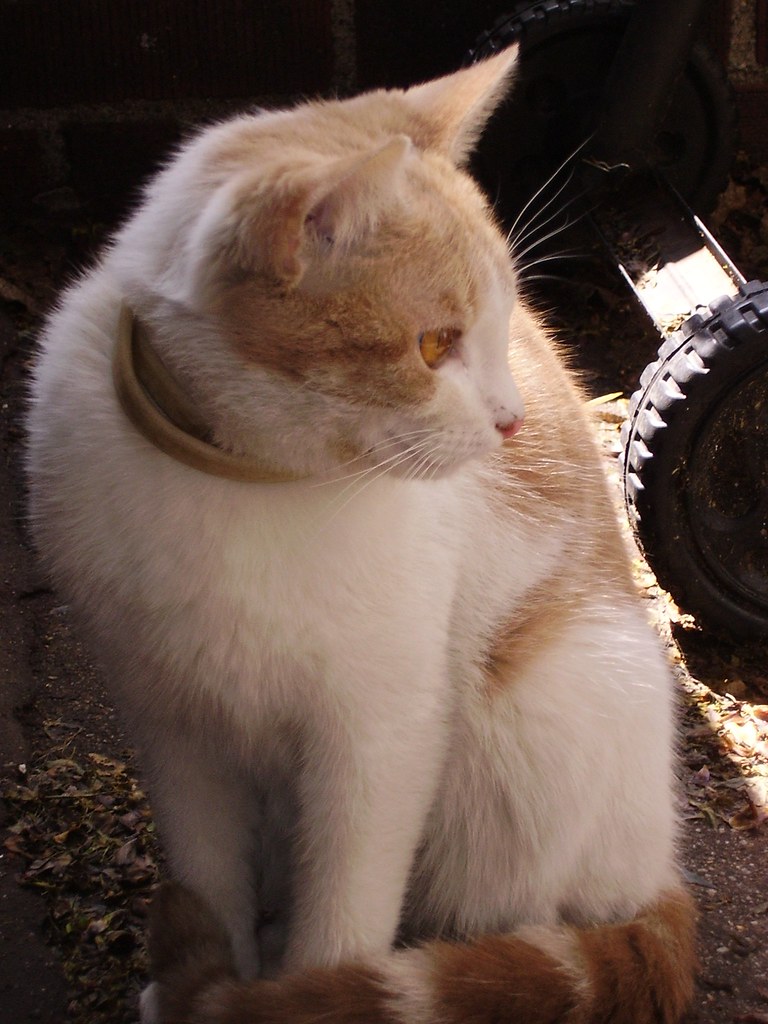
3. We both like to kiss kittens on the belly. Someone, get this man a kitten quick, so he doesn't have to lift little boys' shirts any more. Come to think of it, I have a little bald-bellied redhead I can send him. A cat, I mean, not a boy.

Thursday, July 06, 2006

Sounds Like Writer Heaven

I'm just now catching up...Randa Jarrar blogged through June on her residency at Hedgebrook. Complete with photos of the colony grounds, her workspace, and a very exciting story involving a shirtless hitchhiker. Enjoy vicariously with me.

Tuesday, July 04, 2006

Blog Mini-Makeover = More Time Not Writing.

But it was fun figuring out how to put our kitty Angus in the banner. I just love his stripes. And Willie, at right, loves whipped cream. He doesn't love July 4th so much. Fireworks! Hide!

For Gardeners and Garden Lovers

Degen Pener, one of my college buddies, has got a great, informative blog going, SEEDHEAD. It's loaded with how-tos, species info, news links, and profiles of public gardens. Gorgeous photos too! Check it out!

Monday, July 03, 2006

Spark It! Check Out Hobart 6


Folks, I'm finally in print again, in the new issue of Hobart. They did a great job fixing up my short story "Three Lessons in Firesurfing," and I'm happy to say I'm in excellent company here. The issue is also visually gorgeous. Not only does the cover feature a painting by my old UCSD classmate Perry Vasquez, it has a cool matte/glossy contrast that you have to hold in your hands to appreciate. So order one here, or keep an eye out on your newsstand.

Hobart has also published "bonus materials" on their website. Enjoy!

Sunday, June 25, 2006

On Fences, Beds, and Good Neighbors


Well, we finally replaced that icky rotten fence behind my mulch experiment from last year. You know what they say about fences and good neighbors. So we're trying. I'm sure the guys next door are relieved to be rid of the dog-sized hole that used to be between us...one day my husband and the dog came home to find the neighbor's pit bull in the front garden! The pit bull is sweet, but Willie didn't like that very much.

So we found a contractor who did a clean, fast, fair job. He even spared the volunteer sunflowers you can see here. No wonder the neighbors are all vying for his time. And after a little work this weekend, I have fulfilled my own wish of raised beds in the sunniest spot in our yard. Willie chose a supervisory role in the project, except the part where I dumped out some of the city's free compost. He likes dirt.

This summer, we'll try peppers, yellow squash, Chinese eggplant, and loads of nasturtium, which I like in a salad. (It's like having lily pads on your plate!) And don't believe that thing about planting nasturtiums in crappy soil to get more flowers. I planted ours in pure compost and they are blooming like crazy.

What Can Fiction Writers Learn from Acting Classes?

I aim to find out. I'm going into a research phase on my novel-in-progress, and since my protag is an aspiring actor, I have a lot to learn about how actors relate to each other.

Someone gave me a good tip: acting classes often allow cheap auditing or free trials, so actors can shop for a new teacher. Who says writers can't audit too? So I did my first audit Friday night, at HB Studio in NYC, known for its founders Uta Hagen and Herbert Berghof. I went hoping to take in a scene study class, but since enrollment was low, I ended up in an acting/directing class instead. Whatever, I went with the flow.

The class, taught by Alexey Burago, was focused on keeping the direction of a scene as close to the play itself as possible. The students were using short stories, all Chekhov, I believe, and turning them into acted scenes. Since I missed at least one class meeting, I'm interpolating a lot of info, but my guess is that their charge was to do all of their research/homework inside the text. In other words, not to project or imagine motives that are not explicitly evident in the text itself. Imagination can be good, but it can also lead one away from the literature.

This is harder to do than it sounds. A literal, surface read of any text is not enough to create an interesting dynamic between players. The actors and director must dissect the impulses of the characters from moment to moment, without following unrelated tangents.

One group did a scene where there was an unspoken sexual subtext between two characters. Burago had an interesting take on it: sure, they have sex. Maybe yesterday. Maybe tomorrow. But not in this scene. So what impulse right now is driving the actions of the people? Why is this moment different from other moments? Though it is a little formulaic, it's also a damn good question to ask of any scene in literature. Why now? Why not tomorrow? Why not yesterday?

Another of his comments made me chuckle to myself: writers always instruct each other to show, not tell. But Burago instructed a student: "Don't show it! Live through it." This must be a common theme in the craft of acting; I noticed the same idea came up in the film In America, which happened to be on TV last night. (Great film, by the way, but that's another topic.) I imagine "showing" in this context means a certain awareness of audience, the practice of assembling signs of an emotion or impulse, rather than feeling it and manifesting the involuntary signs of the impulse. So, the actor's version of "telling" is called "showing." It feels a little bit like derivative calculus: maybe living is alpha, showing is beta, telling is gamma? Let's hope I can keep the lexicon straight.

Anyway, I'll be back to acting school. I hope I can remain on the sidelines, observing and notetaking. I have no aspirations to participate, and my great fear is that I will be required to. I don't need the distraction of my own insecurity...

Wednesday, June 21, 2006

You See? Even THIS GUY is a Poet

The Wall Street Journal's Washington Wire had a cute item this week...a White House spokesman told reporters Bush's speech in Budapest will be a "tone poem," meaning he doesn't plan to actually SAY anything, but it will sound really cool.

Next stop, Naropa. I want a sonnet!

Monday, June 19, 2006

There's Glass Between Us!


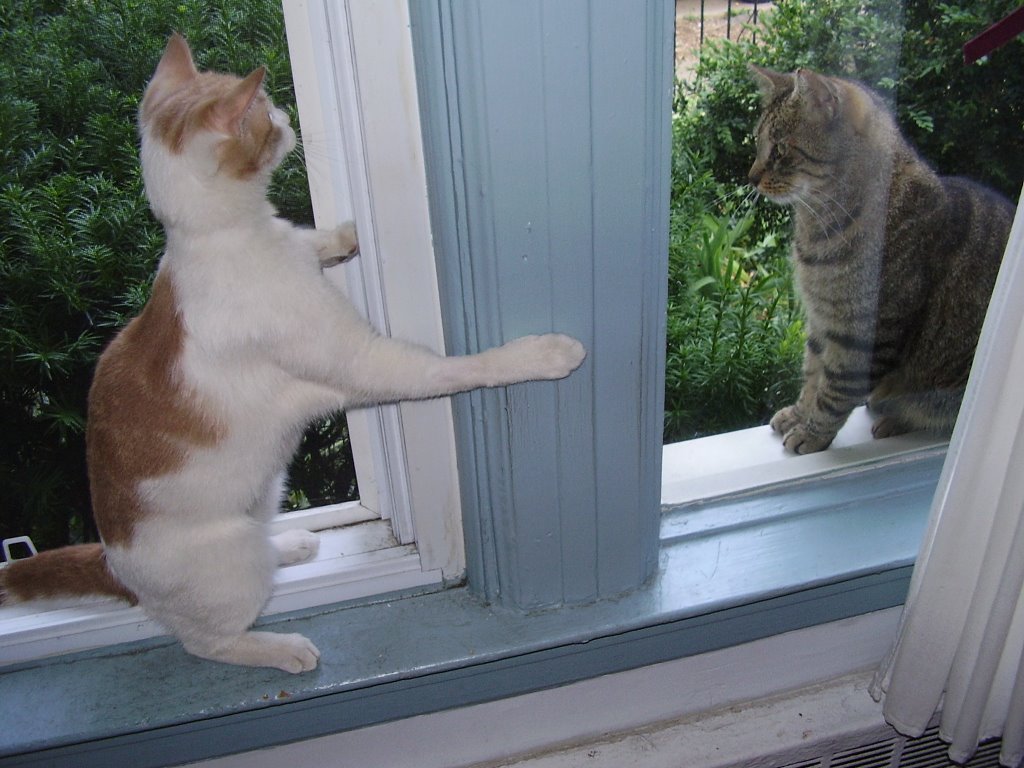
Little Ava, now rid of her hormonal sweetness, is turning out to be a regular tomboy kitten. She plays soccer, she corners poor submissive Angus, and she torments Vince through the window. And she doesn't walk anywhere. Why walk when you can run?

Vince is not pleased. "How come she gets to come inside and I don't? Just because she's a girl?"

Tuesday, June 06, 2006

See You at the Fair?

One of my favorite NYC literary events of the year is this weekend: the CLMP Lit Mag Marathon. On Sunday, June 11, we lowly writers can commune with editors and purchase back issues for $2, benefiting Housing Works. Let's go! See you there? Details:

EDITORS UNLEASHED!
The Magathon
New York Public Library's DeWitt Wallace Periodicals Room, 5th Ave. at 42nd St.
Saturday, June 10th from 4–6:30 PM

The Magathon kicks off the weekend with a celebratory “marathon” reading. Over a dozen readers—editors representing journals of every size and style, from promising upstarts to the oldest, most established—will present favorite selections from their latest issues.
Featured magazines include Call: Review, Columbia, Fiction, A Gathering of the Tribes, Gulf Coast, Home Planet News, Lips, Me Three, North Atlantic Review, Opium Magazine, A Public Space, Skidrow Penthouse, SLAB: Sound and Literary Artbook, StoryQuarterly, Swink, Terra Incognita, Tiferet, and Verbatim: The Language Quarterly.

BARGAINS! BARGAINS! BARGAINS!
Seventh Annual Literary Magazine Fair
Housing Works Used Book Café, 126 Crosby Street in Soho
Sunday, June 11th from 12–5PM
Lit fiends can take home armfuls of lit mags discounted more than 50% at only $2 a copy! Choose from hundreds of magazines from all over the country and hobnob with many of the editors who’ll be present to meet and greet. Proceeds go to Housing Works, a nonprofit organization serving homeless people living with AIDS, and to The Council of Literary Magazines and Presses, a nonprofit organization serving independent literary publishers.

Missed it by That Much

Thanks to Felicia Sullivan of Small Spiral Notebook for this link:

Entertaining blogger Summer Pierre is enjoying a fate we almost had, an infestation of criminally cute orange furry beings. Warning: these pictures might make you weep. I don't know about you, but I have a chemical reaction to cuteness like this.

Ah, if only. I'm pro-choice, but our little knocked-up Ava didn't get to make a choice exactly. We made it for her, and I have some regret. It's hard making choices for our four-footed friends. Heavy sigh. I haven't held a newborn kitten in years. If we didn't already have a cat surplus, it might have been worth letting nature take its course. Nature is not so bad.

The good news: Ava got her sutures removed and is healing well. She's dominant and aggressive. Likes cuddling with the dog, also likes attacking her new feline brother Angus, who is easily cornered and very submissive. She's active, playful, and demanding. Our little Feline American Princess. It's nice not being the only gal in the house. Even if I have to carry a water pistol.

On Milestones, and Irony

It wasn't long ago I was working hard to cut 300 words a day from #1 Novel, STARVING HYSTERICAL NAKED. My agent, an excellent editor, challenged me to remove 10,000+ words from that sprawling opus, and he was dead right.

So what the hell am I doing pushing to write 300 new words (and more) a day on #2 Novel, ALMA? I love irony. I'm happy to report I crossed the 10K milestone last week, and momentum is good. Diving into chapter four. And this is the fun part, even if I'll end up cutting it all. Full speed ahead, even as I cram it into coffee breaks and subway rides.

And what's the new novel about? Should I share, or will that jinx it? Aw hell, why not. An actress/preacher's daughter from a huge interracial family embarks on a new scene study class, and is assigned to explore the preacher's daughter of preacher's daughters, Tennessee Williams' recurring character Alma. Alma = soul. What is the soul, exactly? Especially to us lapsed Christians? I'm dying to figure this out.

But she's not even in the acting class yet. I'm caught up in backstory now, meaning it could be the book or it could be my homework for the book. I may end up cutting all of it, but it's stuff I need to know. About the character, the only one not adopted in her liberal family, and about how the six siblings relate to each other as adults. Adult siblings are a goldmine/minefield of material! Why haven't I played with it until now? Where have I been? I have a rudimentary outline, but I'm not looking at it. I'm just letting the character tell it her own way, which is a big meander. She thinks in circles, same as me.

I'm getting a new appreciation of backstory. What if backstory was the story? Why do we relegate it to the back? What if I called it nonlinear storytelling instead? What is wrong with chaotic reflection? So I'm plunging into the joy of memory, mixing my own experiences with imagined ones. We writers live for this shit.