Saturday, September 16, 2006

I'm Off to the West Coast
I probably won't post for at least a week. I'm off to Seattle and Los Angeles for an overdue visit with my family, plus a couple college pals. I look forward to walking some REAL hills. These gentle slopes of Brooklyn don't quite cut it for this western girl. My brother is even talking about a real hike, to Wallace Falls in the Cascade mountains. If I attempt it, I promise pics for you all.
In the meantime, enjoy wildman poet Todd Colby's brand new blog, Glee Farm.
Or spoil the surprise of Project Runway's big 4 finalist collections, pic links are at Project Rungay. Nice threads! Okay, I admit it. This craftaholic is obsessed with that show. Problem-solving, oddball characters, and needlework. What more could you ask for?
See you all in a week.
Sunday, September 10, 2006
Sharing the Mic with Some of My Favorites
Hey! You Tri-Staters, come on down to Sutra next Saturday and hear me read some actual poetry, with like line breaks and everything.
I'm so stoked to be reading with these people.
SPIRIT OF HOWL! FEST
WHEN: SATURDAY, SEPTEMBER 16 7:30-10:00
WHERE: SUTRA LOUNGE http://www.sutranyc.com
16 1ST AVE(BET. HOUSTON & FIRST ST)
PH: (212) 677 9477
$8 ADMISSION
SLIDING SCALE POETRY PRESENTS:
REGIE CABICO-Regie has appeared on MTV's Def Poetry Jam, PBS's In the Life, and in over 30 anthologies. http://www.globaltalentassoc.com/site/clients/cabico.htm
ANNE ELLIOTT:-Anne is a fiction writer/poet/ ukulelist/ feral cat tamer, and author of the reknowned http://Assbackwords.blogspot.com.
BOB HOLMAN- Recently dubbed a member of the "Poetry Pantheon" by N.Y Times Magazine. Holman has been crowned "Poetry Czar" (Village Voice), "Dean of the Scene" (Seventeen), and this generation's Ezra Pound(San Francisco Poetry Flash). http://www.bowerypoetry.com
SAPPHIRE- Sapphire's books include American Dreams, Black Wings & Blind Angels, and Push; NEA chairman John Frohnmayer was fired when he defended her work.
JACKIE SHEELER- Recently featured in the New York Times, poet laureate of Riker's Island, Jackie has two books and one CD out, is the talk in Talk Engine, and has hosted a weekly reading for the last seven years at Pink PonyWest. http://www.poetz.com
LARISSA SHMAILO-Larissa has a CD, The No-Net World, and teaches the class Publish, Perform, or Perish! http://larissashmailo.blogspot.com
HAL SIROWITZ- Hal is former Poet Laureate of Queens, reads Brooklyn work.
ANGELO VERGA- Angelo is a poet, teacher, editor, curator of literary events, five collections of poetry, currently engaged in "deep research" for a book of love poems.
MC CHOCOLATE WATERS- Chocolate is a pioneer performance artist, director of Eggplant Publications and bon vivant. http://www.chocolatewaters.com
And for more info on other SPIRIT OF HOWL events, click here.
Monday, September 04, 2006
An Interview With Fiber Artist Angus Barr

Angus Barr rests in the middle of his latest perfomance/installation, "Diner."
AE: Angus, I've been following your work for the past year or so, and I am especially curious about the titling. What is the significance of "Diner?"
AB: Sure. The title, like all my titles, is a reference to the timeframe of the work. My benefactors left me with the materials for the duration of a trip to the diner for breakfast. So I usually have a small time period in which to execute a work, but this time I had a good two hours.
AE: Many call your major work of last year, "Ten Minutes," a tour de force.
AB: Well, I was in better shape back then. My benefactors left me with three balls of blue acrylic yarn and they went into the basement for ten minutes.
AE: I saw the result. You managed to unroll three balls and wrap them around chairs, up over tables, and into three rooms.
AB: Yes, my experience in dance and the martial arts was instrumental in that work. I've taken a much more cerebral approach with "Diner," however, plus, I'm working with an assistant, which is an adjustment.
AE: How so?
AB: Well, she's a little green. Enthusiastic, but I'm not used to the verbal interplay. But we'll get there. It's a new process, far less impromptu and improvisational, but due to the larger time frame, we were able to put some care into the placement of the material. I consider this one a drawing, where the other works were more performances.
AE: What are some of the other new aspects of "Diner?" It does feel like a departure.
AB: I'm working with rag strips for the first time. So instead of one long, continuous line, it's a collection of shorter ones. Metered lengths, like bars of music. It's much harder to harness the material, and to draw the eye into neighboring rooms.
AE: Do you consider yourself a formalist? Who are your influences?
AB: Well, there is the obvious draw from Andy Goldsworthy, who was a huge influence on me in my earlier days: his respect for found materials and for the investigative experience. But he has a level of patience that I haven't learned yet. Also, Eva Hesse, from a formal point of view, her sence of gravity and materials. And I've learned a lot from Cy Twombly and his sense of drawing and mark making, the mark as "signature," like handwriting. I also consider myself an American artist, hence the use of traditional craft materials. Yarn, used in the making of afghans (which I enjoy), and now the rag strips, which are traditionally used for woven or braided rugs (which are great to curl up on as well). I have a great respect for artists who work in the tradition of American crafts, such as story-quilt maker Faith Ringgold. They display a resourcefulness and a respect for the past that I find moving. But maybe because my memory is shot, for me it's more about the present. Improvisational play, in the moment. I find inspiration in jazz music too, Miles Davis, Coltrane, whoever my benefactors have on the stereo, I suppose.


AE: I noticed you used the rag strips to frame the Adidas in the center of the work. Do you consider this a nod to pop art, and the presence of brand names in the American psyche?
AB: I don't really think about brand names. I'm a cat, remember. Maybe when it comes to kibble, but I don't follow shoes.
AE: Of course. Which leads me to another question: it's no secret that you spent several years as a homeless feral on the mean streets of Brooklyn, and have experience in gang warfare. I know you've put that life behind you, but do you find any residue of it creeping into your work?
AB: It's hard not to draw that conclusion, though honestly I'm not sure. My homies on the street were graffitists, and their main medium was urine. The problem with olifactory art is that it's limited to a four-legged audience. So getting civilized, and having human benefactors, that's necessitated exploring new materials. Plus, after my mysterious surgery two years ago, my pee is not what it used to be.
AE: Well, thank you Angus for taking the time to talk to us.
AB: My pleasure. Say, is there any food in that bowl?

Wednesday, August 23, 2006
Shall We Loaf, While Loafers Blog?
I didn't get into Bread Loaf this year. Maybe I shouldn't have sent a 2700 word story that uses the word "fuck" 48 times. I mean, 2% of the story was the word "fuck." What was I thinking?
But hey, if I had gotten in, I wouldn't have had the mindblowing experience I did at Lynda Barry's class. (Her educational sidekick says, "Blow your mind...with your own mind!") So I have no regrets. And thanks to the blogosphere, I can get the Bread Loaf experience once removed, without sleep deprivation or mosquito bites.
So, here they are:
Mary Akers is a regular Bread Loaf staffer, who gives not only an inside scoop, but also very detailed accounts of the craft classes. Ursula Hegi sounds like an awesome instructor!
Cliff Garstang is returning to the conference as well, and finds that he can relax a bit more as a result, no longer compelled to do every social event. Sounds like he has found some good insight on a story that he has been struggling with.
Laila Lalami was a waiter last year, and now with a successful book under her belt, is a fellow. She taught a craft class on cross-cultural narrative, has been fighting back big mosquitoes, and is enjoying time away from the computer.
Katrina Denza is there for the first time, and has gained inspiration to work on her novel.
And poets have their moment in the blog spotlight too, thanks to the poetry foundation, who has recruited several dispatchers, starting with the head waiter, who has a new appreciation of the feather boa.
Hey, and if that's not enough, you can read The Crumb, the daily newsletter.
Stone Mosaic by My Old Classmate Leslie Samuels

Wouldn't you love this for your bathroom wall? My friend Leslie designed and built it. We studied performance art together in the MFA program at UC San Diego. Boy, I remember some wild spectacles put on by her and other friends, both in San Diego and here in NYC. I got to be in several of them...as a carnival barker, or a flying angel (hanging by bungie cord--it was FUN!), or a Vestal Virgin.
Like all of us, Leslie has continued to play with materials and images, even if performance is a less frequent endeavor. I turned to writing (and craftaholism), and she turned to stonework. Her years of experimentation with jobsite scraps is really paying off; she definitely knows her way around it, cutting complex curves, veiny leaves, making tabletops, foyer floors, bathroom walls, backsplashes. Check out her new website, my description does them no justice. What a life, on the top of a mountain in North Carolina!
Do you need a new fireplace? Swimming pool? She's available for hire, and might even bring her big, cute Newfoundland to work with her. Or, smaller pieces can be shipped for your local handyperson to install. Sorry, I have no pics of the dog.
It's so fun, watching talented people evolve.
Monday, August 21, 2006
Glitter Folk!
Guys, check out Mr. Solo. I can't stop singing along to his his songs "Genius" and "Industree." Such verve! Such a voice! What haunting eyes! Move over Gary Glitter and David Bowie, there's a new sheriff in town, and he's wearing a big, beatiful cape.
Recommendations on "PK Lit?"

I started Allan Gurganus' PLAYS WELL WITH OTHERS this morning, and I'm kicking myself, thinking, why didn't I pick up this book before? I just happened across it, appropriately, in the fabulous book section of Housing Works Thrift Shop on the Upper West Side. Glad I grabbed it. Anyway, one of the characters is an artist-PK (Preacher's Kid) like me, and it's an interesting, sensitive, funny portrayal through the eyes of his less-Lutheran friend. The book opens with the PK dying of AIDS at St. Vincents Hospital, asking his caretaker-friend to clear all the sex toys from his apartment before the parents show up for a final visit. Poignant, funny--dildoes stacked like "cord wood" in the broom closet--I can't wait to read on.
What does being a preacher's kid do to one's identity? This is one of the themes I'm playing with in my new novel project. And in life, I suppose, though I have other identity "themes" there too. My broom closet is way more boring, but I still identify with the character's impulse to "clean up," even when that seems like a silly notion.

So now I'm brainstorming, trying to think of other works of literature with preacher's kid characters or authors. Any suggestions? I have the complete oevre of James Baldwin on the shelf, and most of Tennessee Williams and Darcey Steinke. Also have Marilynne Robinson's GILEAD on my to-be-read stack. Any others you have enjoyed?
Oh, How I Love My Writer's Group
I just got back from write club, where as usual, I learned a lot. You incredible women! You keep me honest! You read deeply! You write deeply! It's a joy and an inspiration to read your work! And I feel fiercely protective of your work, like I do about my friends' children. You midwives! We all know it's hard, and we're in it together, breathing our Lamaze breaths as the raw, bloody stuff hits the page! We cradle it, clear away the mucus and gunk and gush over the beautiful living thing! Oh, how exciting it will be when the world gets to meet your material!
Thank you!
Thank you!
Saturday, August 12, 2006
Proj Rock! Mudpies, The Grownup Kind.

Have you ever made hypertufa? It's equal parts peat moss, cement, and sand. Add some water and you have some wonderful mud. You can make just about anything out of it...planters, water features, etc. It's porous, so it grows algae and moss nicely, depending on where you put it.

I'm making stepping stones. The molds are rings of cardboard. I line them with garbage bags, which gives them a smooth finish. Ideally, you have a level place to do it, but I don't. It's a crapshoot. Mostly I like mixing the cement.

I put rocks inside them. Hopefully they'll look cool when the cement dries. This is my first experiment with rocks, so I'm not getting too fancy with the design. These are used lava rocks from the barbecue, plus a couple I stole from the beach.

You dump the mud in, then slap it with the tool to get out the bubbles. It looks like jiggling fat! And check it, the two stones together look like a butt!
Friday, August 11, 2006
A Visit from Mad Max!

We just had a wonderful visitor, Max the Cat! He and his person were passing through Brooklyn on the way home to Maine.
Max has had surgery near his spine and so stuff below the waist doesn't work so good. But he gets around just fine, especially when food is involved. You should have seen our feral cats react to the prospect of a paraplegic feline. Like the way young children react to the disabled--what the hell is that!? Plus, he does send off that anger vibe. Though he is softening in his old age.
Only one serious squabble, when Max came near Wilbur the Dog's food. Willie did like he does with dogs: the growl, then the bigger growl, then the full-on attack. Poor Max shit his pants. Only he wasn't wearing any.
Here's Max set up in the passenger seat on his way home. He loves to go for a ride. But you better let him choose the tunes.

A New Era in Security Theatre
Is flying naked the only thing left? I have to thank blogger and securitologist Phil Libin for introducting me to the term "security theatre." It's that that weird post-9/11 paradox where taking visible security measures actually compromises security. Face it: check points of all kinds give us a false sense of safety (that is, if you're not from a "questionable" demographic), and create exactly the kind of human bottlenecks terrorists love. And recent allegedly-thwarted events have launched a new wave of it.
Will hairstyles change now that we can't travel with gel? Will the airlines have enough water to hydrate the passengers? What kind of air rage will ensue when we are denied our own choices for inflight entertainment (ipods, laptops, or even books and pencils), and have to watch the stupid censored movies?
Don't get me wrong. I'm all for thwarting terrorist plots. I saw and breathed some awful stuff downtown 5 years ago, and I do consider myself lucky to be here. But in my opinion, the only effective security measures are invisible ones. Which have their own ethical quagmires. And what thwarts terrorist attacks is not metal detectors, it's plain old espionage, efficient sharing of intelligence, and being awake enough to identify a serious threat. In other words, real intelligence, the kind you have between your ears.
Here are a couple funny archive posts from Phil's blog, Vastly Important Notes. In one, he analyzes the security theatre at a Jamaican airport. And in another, he introduces Mr. Driver's License.
Monday, August 07, 2006
Mark Pritchard's Interviews--I've Joined the Party
If you haven't discovered Mark Pritchard's WAYWO (What Are You Working On?) interviews, check them out. He's just added me to the corral of hard-working writers. While you're at it, look at his blog. Thanks, Mark!
Tuesday, July 25, 2006
More Views on Lynda Barry's Class, and Pics
Well, I'm back in the thick of work and trying to be "present" while I attempt to solve database problems. In the past, I went for "focus," or "concentration," but I like the new name better. I prefer to write graceful, simple code, but it doesn't always come out that way, and I have to pepper it with goofy notes, in case I "get hit by the bus," in my colleague's words. And in my art life, I like to write graceful, simple prose too, but that doesn't happen either. So, my new goal is to practice. And occasionally, the grace comes. And I'm writing "comments" around my fiction too, because there are plenty of buses out there to be hit by. (Knock wood here. The underside of the table is best.)
Other bloggers have weighed in on the Lynda Barry class experience. Virginia, one of the friends I went up there with, found herself in tears one day, and recounted, “I can feel my critical, judging self dissolving, and I’m afraid it may be what holds me together.” Boy, can I identify. And Summer, who I didn't recognize until after I was back home (hey! I read her blog!), found the Lynda Barry teacher-persona discombobulating, after having a relationship with her work for so many years. I can identify with that too.
There were probably other bloggers in the class. If I find them, I'll link to them.
Okay, photos. It was a week of non-editing, but be grateful that I stuck my editor mind back on for posting photos, cuz I shot a lot of em. If you click on the photo, you can see it bigger.

This is the lake at 6 AM.

This is me after my Gilligan experience in the hammock.
 Here's the trapeze rigging they had in the middle of campus. It was Arts Week, and ordinary citizens were there learning to fly.
 On Thursday night, we got to see some of this flying. Plus a mindblowing Mongolian contortionist, and...
 Puppets!! Courtesy of the concurrent puppet workshop. They joyfully pranced through our Thursday nite vegetarian dinner.
 I loved this one. A big guy in a tie, with a red briefcase that said "Dream Job." God, if only.
 On Wednesday, I took a field trip into Woodstock with my friends Marcia and Virginia. We found a house decorated with tile...
 Marcia, an appreciator and collector of visionary art, was determined to find the maker. No luck.
 In Woodstock, we happened upon this grave. He did what he could for the master. I was touched.
 Then we went to another visionary art site, Opus 40. Stone quarried and arranged onsite, a single sculpture spanning 40 years. My inner sculptor was jealous. It was a lesson in stick-to-it-iveness.
 This greeter at Opus 40 was way more friendly than the human greeter, who chided us for not understanding they were closed. Their signage was inadequate.
 A sampling of the veggies we ate daily. These were primarily there for us to contemplate, I think. I never did figure out how they kept the cute rabbits from eating it all. This was where I saw turbaned Kundalini yogis practicing their breathing every morning. Gorgeous swiss chard, cabbage, and sunflowers.
 And finally, I did find some kitty love at Omega. I don't know if I find them or they find me. This one was friendly, and a good hunter. Probably an illegal companion for one of the 250 staff members. (Who were beautiful, earnest, and very fun to talk to as well.)
I wonder how Black Kitty deals with the adorable groundhogs, who are not shy, but still, I did not get to photograph. I'll never forget a fat little Punxsutawney Phil peeking into the yoga pavilion one morning while we all were engaged in asana. We humans must look very weird to them.
Friday, July 21, 2006
The Maker of the Soul

I'm grateful I've lived to see Lynda Barry sing Emily Dickinson's poem, "The Loneliness One Dare Not Sound," a stanza here:
I fear me this -- is Loneliness --
The Maker of the soul
Its Caverns and its Corridors
Illuminate -- or seal --
And if you're thinking Yellow Rose of Texas, you're way off. She set it to the classic Brazilian tune, Girl From Impanema. It was one of the main "images" I took away from her class, Writing the Unthinkable, at the Omega Institute upstate. Writing is a lonely business, one that "causes swelling," in Barry's words, and it's something we practice for our own mental health. Publishing, fame, all that stuff is secondary, and in fact a recent development. Writing has gone on for ages, and words do find ears, or not, and maybe that's not the point. She also recited daily Rumi's poem, The Diver's Clothes Lying Empty on the Beach, which grew in nuance with every recitation. Both Rumi and Dickinson gave work to the world like "seeds," or "spaceships" (Barry's terms), without the problematic goal of publication. And for every Dickinson, she argues, there are thousands we don't know about.
The goal of the class was exploring writing as a form of solitary "play," the kind that nourishes. To bring home the solitude of writing practice, she kept the class totally anonymous, avoiding the primate instinct to establish hierarchy. (She says that monkeys will give up their food for two things: pictures of monkey genitals, and pictures of the top monkeys.) Feedback on our writing was not allowed. Chitchat in the classroom was not allowed. It was not a social occasion. There were maybe 60 people in the class, and I didn't try to make friends with anyone new. And she gave us, or rented us, her teacher persona as an "image," uniform and all, to take home with us. She wasn't there to be our friend, or even our mentor. She was there to share with us her own working toolbox, to help us explore our own memories, and to offer us new memories to take home.
The focus of the class was what she calls "images," which are detailed slices of memory, the seeds, the resonances, concrete moments in time. We did a lot of list-making, then chose items from lists (or let the items choose us), then written response to her questions to bring the images into clearer focus, then timed freewriting. After the freewriting, we were not to reread our work unless we volunteered to read aloud. Then, while volunteers read, we all doodled spirals and focused on our own drawings, like we were listening to a radio show. This process kept the readings anonymous, and encouraged shy people to read, as if they were reading to themselves. Even she didn't look at the readers: she kneeled before us, looking at our bare feet. After each reading, her only response was a heartfelt "good," with a look in the eye.
Eventually, we moved into fiction, using magazine photos instead of memories as prompts. And after the work we had done with our own lives, the responses to the photos were poignantly vivid and concrete, and evoked real empathy. You could feel it in the room.
This system had several results. One is we not only had access to our own images, but a wealth of images from the anonymous throng. Another is that we were encouraged to turn off our own inner editors, in the absence of specialness and "success." And we were freed to access hidden pockets of our own memories--maybe doodling the spirals helped too--which we can choose to use later, or not.
The toolbox is one I will turn to again. I highly recommend her class for writers at all levels. And for other creative people too, especially introverts, who want to feel awake and alive through this kind of practice. It's a good system for breaking through writer's blocks, and for rediscovering the reason we all do this. It's not for recognition. The thing that moved the class participants was the work itself, the process of contemplation, and the permission to do it, warts and all. The warts were the most beautiful parts.
A few more things I will try to practice going forward. Memorize other people's poems. Recite them over and over to discover what is there. Work in series. Journal in lists of images from the previous day. Grab nouns from the lists and use them as timed writing prompts. Use two timers for freewriting: one to tell me it's time to find the ending, another to say stop. And remember why I'm doing this: it's a daily practice I enjoy. I'm doing this to learn and feel things.
The writing class was one of three classes I attended daily there. Before breakfast, I took an optional yoga class, part flow, part Kundalini breathing practice. Before dinner, I did meditation, led by a Zen practitioner, which was 15 minutes of silent sitting, 15 minutes of slow, present walking, 15 minutes of contemplating specific compassionate ideas, and some chanting. I'm on the fence on chanting, but I did it anyway. It's weird to sing words I don't understand. But I did it, because I didn't want to ruin the experience for the person seated next to me.
The combination of the three daily practices: yoga, writing, and meditation, encouraged me to let go of the judgment I carry. Barry argues that we edit all the time, citing her walk across the Omega campus: "beautiful flower, beautiful flower, hate that birdhouse." I'm paraphrasing, but you get the gist. Lynda Barry's class in particular encouraged me not to judge.
Then, like clockwork, the rest of the hippy-dippy arts week confronted me with the exact thing I LOVE to judge: new age mumbo-jumbo, let's all be free and happy, blah blah blah. It was a nice balance, because Barry's class took us into difficult places--the goal was not happiness there, and anger was allowed. But because of her anti-hierarchy approach, I was gentler with myself, and gentler with these other human beings, many of whom were trying to heal themselves from great physical and psychological suffering.
So, it didn't kill me to chant a little in languages I don't know. Plus, singing feels good. It feels so good that I even took a sampler class for Sister Alice Martin's Gospel Community, and sang along with everyone else, some of whom were moved to dance. If you know me, you know that hymn-singing is a sensitive area for me. I've left the church, and anything churchy can be traumatic. But I let myself enjoy the happy contagion. I let it be the same as the chanting. It just feels good to let the voice out, and to feel the larger voice around me.
Lots of tears, lots of laughs, lots of contemplation, lots of vegetarian food, and I do feel more open-minded as a result. Now, back to the real world. I hope I can keep some of this with me. I have more photos too, maybe I'll dump them into a new post.
Monday, July 17, 2006
My Granola-Eating Week So Far

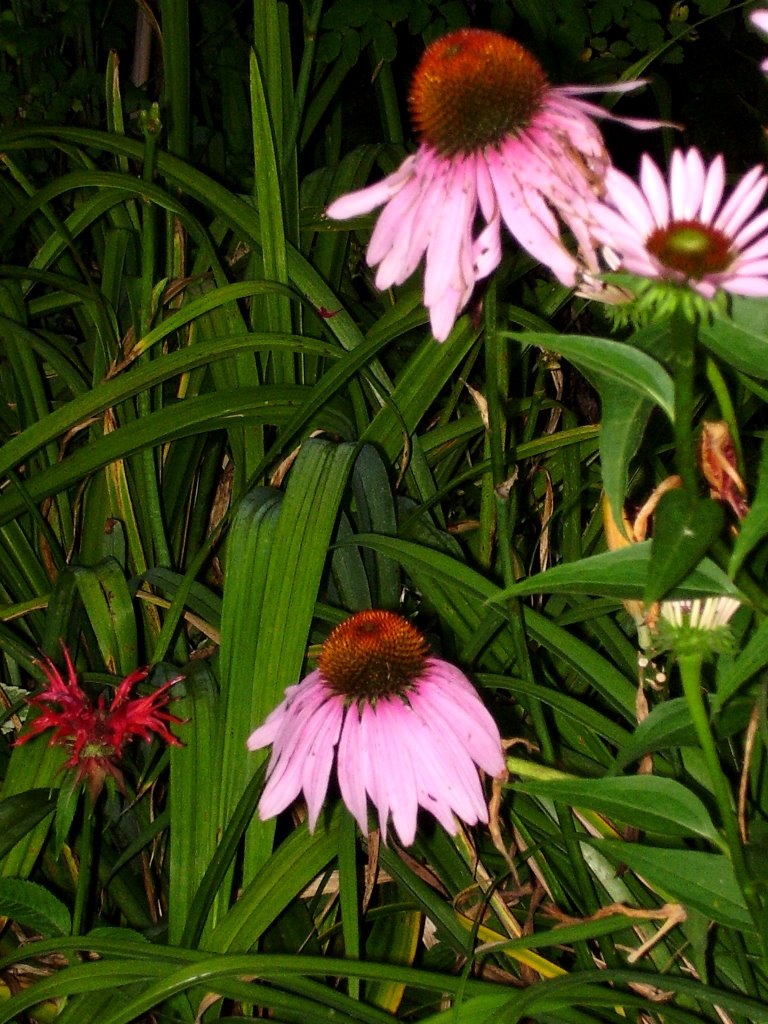
Well, it's only Monday of my week-long stay at the Omega Institute, but I've learned stuff anyway. Like:
1. Baby rabbits are cute as hell.
2. So are baby fish, especially when they swim around your feet.
3. If you get up at 5 AM you see more of the above.
4. I have to try growing Echinacea (see picture). Such audacious blooms, sticking out their tongues as you walk by.
5. If everyone leaves their shoes at the door, there are NEVER any two pairs alike. At least I haven't seen any. Shoe diversity is good.
6. I'm not as inflexible as I thought, though I am still totally uncoordinated. Sometimes I can't tell my left leg from my right arm. I'm trying to roll with it.
7. Lynda Barry exceeds expectations. It's part stand-up, part writing class, all aimed at working with images. More on this later (maybe). Good so far.
Friday, July 14, 2006
Dave King Tells All on Bat Segundo Show


If, like me, you're a fan of Dave King's wonderful debut novel, THE HA-HA, then pop on over to the Bat Segundo show and hear King divulge some of his trade secrets to Ed Champion. It's a true peek under the hood. You get to hear about the iambic pentameter version of the novel, as well as the ending that struck early readers dumb...(he's since changed it). You also hear about the care he took to keep the tone light, almost informational, to avoid turning this super-dramatic subject matter into movie-of-the-week treacle. King is articulate, humble but not insecure, and really seems to have both feet on the ground. It's also nice for me to hear about another writer who started out as a visual artist. A true role model for us fiction beginners, and a very entertaining and educational podcast.
Thursday, July 13, 2006
More Vicarious Living...This Time Misty Oregon
In case you're wondering what happens at the Tin House summer workshops, check out Stephanie Anagnoson's blog. She's getting some face time with online friends, experiencing the notorious Pacific Northwest "wet air," enjoying a very supportive (and non-Iowa-model) workshop with Jim Shepard, and falling behind on sleep, which I've heard is an issue at these summer things.
Sounds like Tin House is giving Bread Loaf a run for its money. Will it be the new envied summer destination? Is it already? I think I'll apply next year. Maybe I'll apply to all of them...improve my odds a little.
Meanwhile, I have my own summer destination looming. I'm off to art camp this Sunday at the Omega Institute, for a week of yoga, canoeing, meditation, garden-walking, and a generative class called Writing the Unthinkable, taught by the incomparable Lynda Barry. I hope it's what the doctor ordered. I have my loose leaf notebook ready.
Wednesday, July 12, 2006
Getting Out of the Way
Well, folks, I'm chipping away at Novel #1 again, to see if it's a sow's ear or what. The theme of this revision is simple: Get the hell out of the way.
Taking stock, trying to be honest and not fake-humble: I'm okay with building characters, maybe even good at it. And sure, the characters have plausible feelings about each other. And okay, I'm starting to get the hang of my voice. But I have a major weakness--plot.
At least that's how I feel about it today. The story lacks clarity of conflict and/or quest. Readers like the protag, maybe even love her. But they want to fall in love with the story too.
So here's the experiment--assume the weaknesses of plot are all due to the Grand Design I imposed on the project way back in the planning stages. Let go of the plan. Let go of the Rashomon storytelling conceit. No external maps allowed.
I started out about ten (ach! embarrassing!) years ago, thinking I would write a metaphor-driven novel. Readers' response: "I see it has these sustained/recurring themes. But what's it about?"
Not being a plot person, I then set out to turn it into a character-driven novel. Reader response: "These characters are cool. But what's it about?"
So I go back to the manuscript, thinking maybe if the prose was cleaner, the message would be clearer. Trimmed a lot of fat. Reader response: "Nice prose. What's it about?"
Hmmm. All these comments are flattering and encouraging, but also confusing. What, exactly, does that question mean?
My interpretation-of-the-day: these readers are not looking for morals-of-the-story. They want to go for a ride. The work I've already done will help in this capacity, but it may not be enough. And the new shape has to come from inside the story. Sure, I wrote it, but now it's time for me to shut up and listen. Get out of the way of the story that's already there.
I tire easily of discussions on crafting plot. "Raise the stakes!" "Beginning-middle-end!" "It needs an arc!" "Put your characters in real jeopardy!" Maybe this is why I've resisted the notion of plot itself--it feels too much like a screenwriting class rehash. Parroting mottoes, without questioning the authority we've bestowed upon them. It's too gimmicky. It's too formulaic. It makes me grumpy.
But this new (to me) approach, maybe I'll be able to forget what I'm after and find what readers are after. Get out of the way, don't hide the story with language and fluff, don't try to be clever, and don't blindly conform to the Freitag Triangle master plan either. Ask questions instead. Like: why is this night different from other nights? Why now, this character epiphany? What conflagration triggered it? Then, maybe, the characters will drive the bus, and the readers will be more willing to hop on for the duration.
Plus, it will be way, way shorter. That never hurts, when you're pitching a first novel. The thick ones get read last, I've been told.
Monday, July 10, 2006
My First Fiction Review Ever!
Matt Bell is reviewing all the material in Hobart 6, including my piece, "Three Lessons in Firesurfing." I couldn't be more stoked. It's the kind of review we live for:
Sara's obsessed with both the known quantities of personal items and in the covering up of what is personal. Later, as she rediscovers these objects, she finds them changed by her actions, which has made them both functionally useless and artistically alive at the same time. By being hidden and then uncovered, they become something else completely, requiring new modes of thinking about them. This change is also reflected nicely in the ensemble of characters that inhabit the story.
Part of almost all coming-of-age stories is the recognition that the other characters are just as confused and scared as the narrator, and that by recognizing this quality in others the narrator can learn to deal with it in herself.
That seems to be my theme, or maybe my broken record, but regardless, it feels great to get it across. Read the rest of the review here.
Subscribe to:
Posts (Atom)