I was browsing and happened across this very cool recipe blog, featuring a CAT BOX CAKE! And a beautiful, cookbook-quality photo. It's amazing what can be done with tootsie rolls and a microwave.
Willie our dog would probably prefer to eat from the real cat box, but for the rest of us, this is the shit!
Friday, October 28, 2005

Thursday, October 27, 2005
Why I Love Brooklyn...It's the Dirt

So I actually read my snail mail a couple weeks ago and saw the announcement for compost give-back from the NYC Sanitation Department. They have a compost facility way the heck out in Canarsie, and I drove out there with a bunch of bags in the back of the Subaru Wagon.
It was one of those cool cross-sections of NYC, like the subway. People of all shapes, sizes, colors, and languages, shoveling the free compost into bags. A guy from New York's Strongest helped me load a half a dozen bags. Here's how it looks in our garden! The lasagna bed is coming along: a layer of newspaper, then peat moss, then topsoil, then fireplace ashes (I'm improvising now) and now compost. Maybe we'll be able to grow some great heirloom veggies next year!
Wilbur chimed in with his opinion. WOOF! Translation: "I LOVE DIRT!"

WORD BY WORD on Podcast
I finally figured out how to get Jordan Rosenfeld's WORD BY WORD podcasts into my iTunes. I may be the last to figure out stuff like this so bear with me. This is a great improvement, since I have trouble connecting to KRCB streams, and now I will have a local archive, and won't miss any future content!
Today I listened to her wonderful 10/17 interview with TC Boyle. A great focus on process and the writing life, including Boyle reading an excerpt of a story. Boyle downplays his prolific writing life, makes it sound like the most fun job in the world. He also speaks frankly about talent, and about how the lucky folks are the ones who figure out what their talents are.
(I have no idea what my talents are. I only know I enjoy writing, even though it may prove to be more hobby than vocation. All I know is I'm having fun. And struggling, too, but mostly having fun.)
If you haven't heard her shows yet, Rosenfeld is an insightful interviewer, focusing not only on the work, but on the day-to-day of writing, nuts and bolts stuff that we writers crave. This writer anyway.
Here's how to get it into iTunes (and you techies, don't laugh at me):
1. go to http://krcb.podgram.net/
2. in iTunes, the Advanced menu, click Subsribe to Podcast.
3. copy or drag the url next to Jordan's beautiful picture into the iTunes dialog box.
I don't recommend using KRCB's application Personal Translator (please, no offense). I tried it, and it didn't work well with my other applications open. This is necessary if you're going to listen to internet radio at work.
Thank god for public radio, and thanks to Jordan Rosenfeld for a great program.
Today I listened to her wonderful 10/17 interview with TC Boyle. A great focus on process and the writing life, including Boyle reading an excerpt of a story. Boyle downplays his prolific writing life, makes it sound like the most fun job in the world. He also speaks frankly about talent, and about how the lucky folks are the ones who figure out what their talents are.
(I have no idea what my talents are. I only know I enjoy writing, even though it may prove to be more hobby than vocation. All I know is I'm having fun. And struggling, too, but mostly having fun.)
If you haven't heard her shows yet, Rosenfeld is an insightful interviewer, focusing not only on the work, but on the day-to-day of writing, nuts and bolts stuff that we writers crave. This writer anyway.
Here's how to get it into iTunes (and you techies, don't laugh at me):
1. go to http://krcb.podgram.net/
2. in iTunes, the Advanced menu, click Subsribe to Podcast.
3. copy or drag the url next to Jordan's beautiful picture into the iTunes dialog box.
I don't recommend using KRCB's application Personal Translator (please, no offense). I tried it, and it didn't work well with my other applications open. This is necessary if you're going to listen to internet radio at work.
Thank god for public radio, and thanks to Jordan Rosenfeld for a great program.
Wednesday, October 26, 2005
Calling All Catamounts: Shteyngart Interviews Lipsyte
 If you are like me and fell in love with Teabag in Sam Lipsyte's HOME LAND, then check out this interview on Loggernaut. Gary Shteyngart, author of the hilarious RUSSIAN DEBUTANTE'S HANDBOOK, pulls perfect morsels out of Lipsyte's work, like:
This is Teabag speaking to his principal, Mr. Fontana: "Some nights I picture myself naked, covered in napalm, running down the street. But then it's not napalm. It's apple butter. And it's not a street. It's my mother."
It's the jarring nonsequiturs and mother-love that makes Teabag, and other Lipsyte protags, win my heart. I went all over NYC looking for VENUS DRIVE, and where do I find it? In Istanbul, Turkey. Groovy UK edition. I know I'm not alone in my Cult of Lipsyte, and if you're not onboard, please, get with the program.
And Shteyngart, he's no slouch either, a pioneer (and probably the funniest) in the new milennium's Russian-American literary movement. My favorite moment in RUSSIAN DEBUTANTE:
"Vladimir, how can I say this? Please, don't be cross with me. I know you'll be cross with me, you're such a soft young man. But if I don't tell you the truth, will I be fulfilling my motherly duties? No, I will not. The truth then..." She sighed deeply, an alarming sigh, the sigh of exhaling the last doubt, the sigh of preparing for battle. "Vladimir," she said, "you walk like a Jew."
Another mom moment. And they do discuss Jewish fiction in the interview, the "done" American version, and the newer, immigrant version. I'm not a Jew, I'm not qualified to rehash or analyze. Only to recommend.
Sunday, October 23, 2005
Bombay by the Pound; or, I Can't Believe I Ate the Whole Thing
Well, I just finished the first of my literary birthday gifts, this one from a friend visiting from Mumbai. He said, "This really captures the feeling of Bombay," then handed me the 935 page, 2lb-11oz paperback UK edition of Gregory David Roberts' SHANTARAM. Unbeknownst to me, it is an international bestseller. My friend noticed my discomfort at the size of the book: "Just read the first 100 pages, it's worth it."
I trust this friend, and I am curious about Bombay. But more than that, I'm curious about what makes this material warrant the book's absurd scale. My first novel, which at a mere 120 thousand words (about 350 print pages) has been called "big" and "sprawling" in the nicest and most helpful ways by those rejecting it, will probably never see print in its current configuration. So what does SHANTARAM have that made publishers ignore its violation of the cardinal rule of debut fiction: keep it simple?
In a word: PLATFORM. This is an autobiographical novel with one of the best author platforms I have ever seen. Roberts was a reformed heroin addict in an Australia prison, doing a hefty sentence for armed robbery. He escaped prison, went to India on a fake New Zealand passport, toured India and learned to speak Marathi, Hindi, and Urdu like a native, lived in a Bombay slum where he opened a free clinic, joined the Bombay mafia and worked in black market currency and passports, dabbled in the Bollywood movie biz, went on a gunrunning mission in Afghanistan during the war with Russia, eventually got caught in Europe, and then served out his remaining sentence for the Australia crimes. In the book's acknowledgements, he notes that 600 pages of his original manuscript, penned in prison, were lost.
(Meaning the story was supposed to be 1500 pages?)
I'll try not to bitch about the length, especially since it's what kept me reading. That nagging question: why is it so big? I concluded that it simply suffers from the problem that many autobiographical first novels suffer, the need to include every good idea, every insight, every interesting character, as if there will be no more novels after this one. And while I did find myself wishing Roberts had saved some of the material for his next opus, I must concede that it feels well-researched, and it REALLY makes me want to go to Bombay. The book's architecture is meandering, but so are the slums of Bombay, and so I'll cut him some slack.
Some critics have complained about Roberts' "larger than life" characters, which is a term I'm struggling with now. As in too colorful, too implausible? If so, I disagree. I, like Roberts, am a person who is drawn to weirdos. They do exist. There is no need to write bland characters, or to be bland in life.
But if "larger than life" means cliche, then maybe I see critics' point. One does get tired of hearing about the winning smile of Prabaker, the protag's first friend in India, or the liquid green eyes of Karla, the aloof love interest. But so what. This book is a ride. A long, long, ride, like a Bollywood movie, complete with bad guys and a dancing bear. So maybe the movie could be edited. Maybe the hero wins too many battles or has too much flowery, good sex. (I mean really, no fumbling or bumbling? No icky fluids?) So what if it falls into that story paradigm of cross-cultural searching and assimilation. My Indian friend wasn't offended. It's a little like Roberts' take on visiting India: you just gotta trust and ride.
Aside: while I was reading this book, I noticed Vikram Chandra sold a 1200-page novel about the Bombay crime and movie underworld. Is this becoming a genre? The Bombay supernovel?
Friday, October 21, 2005
Let's Go Get Some Dogs at Nathan's!

What's this German Shepherd doing on top of Nathan's Famous in Coney Island? What else? BEGGING.
We had a great visit with my folks, just now getting through the pics. The boardwalk, Turkish dinner at Sahara, Brooklyn Botanic Garden. Hey, we even went into Manhattan a little, to check out the Russia show at the Guggenheim.
HEY, YOU GONNA EAT THAT?

This Is NOT a Cat

My husband happened to catch this critter hanging out on top of our garage. He's absolutely fearless. He menaces the feral cats. One night recently I was walking home and he was coming the other way. At first I thought it was Vince. Then I realized this guy was rounder, with a bushier tail and a pointier nose. And then he walked right past me on the sidewalk as if I didn't exist. I thought, OK, you are a real New York raccoon, you even have the street etiquette down.
I am very glad all our feral kitties have their rabies shots.
Is this really Brooklyn? We've seen squirrels, possum, and raccoon in our yard...what's next? Please don't say skunk.
Thursday, October 20, 2005
Digging Through the Mothballs.
Fellow Pussy Poet Janice threw it down on her blog, bravely posting her 12-year-old poem, "The New, Improved Girlfriend." I miss hearing that poem!
I take it as a dare. How else can I?
Mine's not as pride-worthy as hers, but it's still fun to dig through the mothballs of my memory. (Since this is seriously four computers ago and my brain's the only place it is stored.) Drumroll...here's my old pathetic lust-poem, practically old enough to vote. And I'm NOT reading this tonight at KGB.
indelible
i want to get under your skin
like your needle
fat with ink
that penetrates
in and again and again
and when you wipe your blood away you find
those pricks have intercoursed to lines
you and I are Celtic
carved in flesh of your bicep
arms and legs woven
under or over
or around or
inside out
arms and legs that don't fit
neatly into
prepositions
but fall square in their own design
a labyrinth of sins
where your skin ends
an mine begins
I take it as a dare. How else can I?
Mine's not as pride-worthy as hers, but it's still fun to dig through the mothballs of my memory. (Since this is seriously four computers ago and my brain's the only place it is stored.) Drumroll...here's my old pathetic lust-poem, practically old enough to vote. And I'm NOT reading this tonight at KGB.
indelible
i want to get under your skin
like your needle
fat with ink
that penetrates
in and again and again
and when you wipe your blood away you find
those pricks have intercoursed to lines
you and I are Celtic
carved in flesh of your bicep
arms and legs woven
under or over
or around or
inside out
arms and legs that don't fit
neatly into
prepositions
but fall square in their own design
a labyrinth of sins
where your skin ends
an mine begins
Friday, October 14, 2005
Reading and Some Auld Lang Syne
Get out your crying towels, it's a reunion! (Well, sort of.) If you're in NYC & available, come by KGB on Thursday October 20th. I'll be reading new stuff, most likely from a novella. Not sure what the other gals will read.
RETURN OF (SOME OF) THE PUSSY POETS!
with
Anne Elliott
Janice Erlbaum
Gloria
with your hostess, Kathleen Warnock
Thursday, October 20, 7pm.
FREE.
KGB Bar85 E. 4th St.NYC
www.kgbbar.com
THE PUSSY POETS were a gang of five loudmouth women out to prove feminists didn't have to be puritans. They got together in 1992, made a big splash, performed throughout the city, got their pictures in a few magazines, and then, having used up their 15 minutes of notoriety, imploded in 1993.
Three of the former members will be reading Oct 20th: Gloria, now vocalist for the band Kanipchen-Fit; Janice Erlbaum, author of Girlbomb: A Halfway Homeless Memoir (forthcoming from Villard!); and Anne Elliott, now ukulelist, fiction writer, and publisher of Big Fat Press.
RETURN OF (SOME OF) THE PUSSY POETS!
with
Anne Elliott
Janice Erlbaum
Gloria
with your hostess, Kathleen Warnock
Thursday, October 20, 7pm.
FREE.
KGB Bar85 E. 4th St.NYC
www.kgbbar.com
THE PUSSY POETS were a gang of five loudmouth women out to prove feminists didn't have to be puritans. They got together in 1992, made a big splash, performed throughout the city, got their pictures in a few magazines, and then, having used up their 15 minutes of notoriety, imploded in 1993.
Three of the former members will be reading Oct 20th: Gloria, now vocalist for the band Kanipchen-Fit; Janice Erlbaum, author of Girlbomb: A Halfway Homeless Memoir (forthcoming from Villard!); and Anne Elliott, now ukulelist, fiction writer, and publisher of Big Fat Press.
Wednesday, October 12, 2005
Introducing...the Blooker Prize!
A new prize in the UK for books based on blogs. So cute I almost think it's a hoax.
Sunday, October 09, 2005
Our Version of Preparedness

When one is at a loss for blog content, the easiest thing to do is just put clothes on the animals and take their picture.
This new rain slicker proved very useful in the big downpour we had on Saturday. No more wet dog trying to jump on the bed!
I was hoping to use the weekend to make the garden prettier in advance of my folks visit, but Mother Nature told me to stay indoors. For the most part, I obeyed, and the plants outside are looking pretty happy from the rain.
Friday, October 07, 2005
Me and Sherman Alexie: 39
The fabulous Sherman Alexie and I both turn 39 today. Happy birthday Sherman! We caught up with Jack Benny!
Me, I think it feels good to teeter on the precipice of adulthood. Almost there. Perpetually.
Here’s the planned celebration (just me and hubby): a nice Japanese dinner in Far Brooklyn, and playing with my new electric ukulele, if it arrives on time. And my folks are coming to visit next week too! Life is good.
Me, I think it feels good to teeter on the precipice of adulthood. Almost there. Perpetually.
Here’s the planned celebration (just me and hubby): a nice Japanese dinner in Far Brooklyn, and playing with my new electric ukulele, if it arrives on time. And my folks are coming to visit next week too! Life is good.
Thursday, October 06, 2005
Saunders: Fables, Crippled Diction, Genocide, and Happy Face
Michael Silverblatt's latest Bookworm broadcast is one worth listening to more than once. He interviews the incomparable George Saunders, who in his beautiful Chicago accent, says, "Give me this crippled diction and make it walk!"
The subject is Saunders' new novella, THE BRIEF AND FRIGHTENING REIGN OF PHIL, and the discussion turns (how can it not?) to Saunders' interest in the institutional language that accompanies lying. From corporate cover-ups to ethnic cleansing.
Silverblatt observes that Saunders' "laughter language" always is "characterized by profuse overadequacy to its situation." But that the "tear language"--which is the same language--is inadequate to its situation. Here's a snippet:
Silverblatt:
The stories are engineered so that the things that made you laugh suddenly have a second side, an ulterior motive...
Saunders:
As they say in Chicago they come back to bite you in the ass.
Silverblatt:
That's what they say. And suddenly you feel guilty for having laughed so easily. The stories are meant, I think, to let the reader feel an uncomfortable guilt at how much is assumed by easy language.
Saunders:
I was thinking about the fact that I am a very sentimental person. I mean, Kahlil Gibran was a tough guy, compared to me. And I am also very conscious that I want to be liked all the time. That's my number one thing. Also I'm not all that crazy about myself. I'm very anxious about myself. So when you put those things together, it kinda makes sense--and I can feel myself doing it--that you're going to keep a "happy face," that language-attentiveness-to-style as a form of a "happy face" thing, and I think that when those "tear" moments come they always surprise me. It's not planned, but I think it's the inevitable outcome of somebody who is keeping too stiff a back.
Very humbling to hear Saunders talk like this. Also to hear his spot-on impersonation of Valley-speak, to illustrate the kind of real-world language he has grown to value, following, in a way, the American tradition of Mark Twain.
I won't rehash more. But do listen.
The subject is Saunders' new novella, THE BRIEF AND FRIGHTENING REIGN OF PHIL, and the discussion turns (how can it not?) to Saunders' interest in the institutional language that accompanies lying. From corporate cover-ups to ethnic cleansing.
Silverblatt observes that Saunders' "laughter language" always is "characterized by profuse overadequacy to its situation." But that the "tear language"--which is the same language--is inadequate to its situation. Here's a snippet:
Silverblatt:
The stories are engineered so that the things that made you laugh suddenly have a second side, an ulterior motive...
Saunders:
As they say in Chicago they come back to bite you in the ass.
Silverblatt:
That's what they say. And suddenly you feel guilty for having laughed so easily. The stories are meant, I think, to let the reader feel an uncomfortable guilt at how much is assumed by easy language.
Saunders:
I was thinking about the fact that I am a very sentimental person. I mean, Kahlil Gibran was a tough guy, compared to me. And I am also very conscious that I want to be liked all the time. That's my number one thing. Also I'm not all that crazy about myself. I'm very anxious about myself. So when you put those things together, it kinda makes sense--and I can feel myself doing it--that you're going to keep a "happy face," that language-attentiveness-to-style as a form of a "happy face" thing, and I think that when those "tear" moments come they always surprise me. It's not planned, but I think it's the inevitable outcome of somebody who is keeping too stiff a back.
Very humbling to hear Saunders talk like this. Also to hear his spot-on impersonation of Valley-speak, to illustrate the kind of real-world language he has grown to value, following, in a way, the American tradition of Mark Twain.
I won't rehash more. But do listen.
Tuesday, October 04, 2005
My Antonia and Book-Flinging Syndrome
I've had several false starts trying to write about Willa Cather's MY ANTONIA. I'm still crazy about Cather's clean prose, this time a first-person "memoir" by Jim Burden, a Virginian transplant to the Nebraska plains. Widely seen as Cather's stand-in, Jim knows what Cather knows: that the immigrant girls are way more interesting than the "American" ones, that vast expanses of land can be both beautiful and stifling, that a woman can gain great satisfaction through independence (and often "men's" work), and that tolerance of other cultures and religions is the Right Way to Live.
But each time I sit down to write about this book, I get stuck on this paragraph:
"Good evening, gentlemen. No ladies here? Good evening, gentlemen. We going to have a little music? Some of you gentlemen going to play for me this evening?" It was the soft, amiable Negro voice, like those I remembered from early childhood, with the note of docile subservience in it. He had the Negro head, too; almost no head at all, nothing behind the ears but folds of neck under close-clipped wool. He would have been repulsive if his face had not been so kindly and happy. It was the happiest face I had seen since I left Virginia.
Oh my. It's hard to keep from flinging the book across the subway car and grabbing the bible of the lady next to me, just to rinse out my brain. Cather has broken almost every modern rule of sensitive depiction: from the love-our-darkies Southern nostalgia to the farm-animal comparison. ("Wool?") Okay. Deep breath. Read on. It's an old book, remember?
Cather's Jim goes on to describe how this black man became a pianist, and the story is compelling and fairly sensitive. As a little boy, this servant's son, blind, eavesdrops on the piano lesson of this young rich (white) girl. When he hears everyone leave the room, he sneaks in through the window and imitates what he has just heard on the keyboard. The teacher and the student both recognize the boy's talent, and nurture it through advanced classical schooling. The poor maid's son becomes a piano-playing star.
Cather was as PC liberal as it got back her day. Butch, almost-out lesbian, always striving for diversity in her fiction, depicting Latinos, Eastern Europeans, and Scandinavians, both poor and wealthy, with a level of sensitivity we expect even in today's literature. So how on earth did this one sickening paragraph make it into print?
Truth is--and this is what I fear--the most earnest among us cannot see our prejudice. We can't predict the evolution of language. (Look what's happened to "queer" and "nigga" in the last 20 years.) What is provacative in one way today will likely be provocative in another way tomorrow. What's harmless background music today will become tomorrow's hurtful cliche. Our words outlive us. Can we trust future literary historians to cut us some slack?
And what other solution is there for writers? Should we avoid writing about diverse populations for fear of accidentally offensive language? If we believe in diversity and tolerance, isn't this kind of segregation a scarier solution? If it's "write what you know," are we only allowed to "know" people who are exactly like us? (Which is pretty near impossible in my neighborhood?)
Or, do we do like Cather and dive into the work, and make peace with the fact that we will probably offend some day? Isn't clumsy writing about race better than none at all?
I've decided to cut MY ANTONIA a little slack--maybe my white skin makes it easier--after all, HUCKLEBERRY FINN has been cut slack for years. And I've decided to cut myself some slack too. Ethnically diverse characters carry specific risks for writers of any race, primarily the big narrative cliches: fascination with "other," the collecter/colonialist/Jungle Fever syndrome. Or the opposite: the story of triumphant assimilation--How I Became a Real American Too--LOOK! ALL HUMANS ARE THE SAME!
For me, the truth is somewhere in the middle, in the awkward, painful moments when characters notice their own prejudices. Like this one, from MY ANTONIA:
Mr. Shimerda rose, crossed himself, and quietly knelt down before the [Christmas] tree, his head sunk forward. His long body formed a letter "S." I saw grandmother look apprehensively at grandfather. He was rather narrow in religious matters, and sometimes spoke out and hurt people's feelings. There had been nothing strange about the tree before, but now, with some one kneeling before it--images, candles...grandfather merely put his finger-tips to his brow and bowed his venerable head, thus Protestantizing the atmosphere.
and after Shimerda leaves Jim's house:
As we turned back to the sitting-room, grandfather looked at me searchingly. "The prayers of all good people are good," he said quietly.
This is overwhelmingly the message of the novel, that the immigrants teach as much as they need teaching, and that the learning is humbling for all involved. I heartily recommend MY ANTONIA, for the history lesson, for the voice, and for the fleshy primary characters. But you might want to skip page 118.
(Depending on your edition, of course...)
But each time I sit down to write about this book, I get stuck on this paragraph:
"Good evening, gentlemen. No ladies here? Good evening, gentlemen. We going to have a little music? Some of you gentlemen going to play for me this evening?" It was the soft, amiable Negro voice, like those I remembered from early childhood, with the note of docile subservience in it. He had the Negro head, too; almost no head at all, nothing behind the ears but folds of neck under close-clipped wool. He would have been repulsive if his face had not been so kindly and happy. It was the happiest face I had seen since I left Virginia.
Oh my. It's hard to keep from flinging the book across the subway car and grabbing the bible of the lady next to me, just to rinse out my brain. Cather has broken almost every modern rule of sensitive depiction: from the love-our-darkies Southern nostalgia to the farm-animal comparison. ("Wool?") Okay. Deep breath. Read on. It's an old book, remember?
Cather's Jim goes on to describe how this black man became a pianist, and the story is compelling and fairly sensitive. As a little boy, this servant's son, blind, eavesdrops on the piano lesson of this young rich (white) girl. When he hears everyone leave the room, he sneaks in through the window and imitates what he has just heard on the keyboard. The teacher and the student both recognize the boy's talent, and nurture it through advanced classical schooling. The poor maid's son becomes a piano-playing star.
Cather was as PC liberal as it got back her day. Butch, almost-out lesbian, always striving for diversity in her fiction, depicting Latinos, Eastern Europeans, and Scandinavians, both poor and wealthy, with a level of sensitivity we expect even in today's literature. So how on earth did this one sickening paragraph make it into print?
Truth is--and this is what I fear--the most earnest among us cannot see our prejudice. We can't predict the evolution of language. (Look what's happened to "queer" and "nigga" in the last 20 years.) What is provacative in one way today will likely be provocative in another way tomorrow. What's harmless background music today will become tomorrow's hurtful cliche. Our words outlive us. Can we trust future literary historians to cut us some slack?
And what other solution is there for writers? Should we avoid writing about diverse populations for fear of accidentally offensive language? If we believe in diversity and tolerance, isn't this kind of segregation a scarier solution? If it's "write what you know," are we only allowed to "know" people who are exactly like us? (Which is pretty near impossible in my neighborhood?)
Or, do we do like Cather and dive into the work, and make peace with the fact that we will probably offend some day? Isn't clumsy writing about race better than none at all?
I've decided to cut MY ANTONIA a little slack--maybe my white skin makes it easier--after all, HUCKLEBERRY FINN has been cut slack for years. And I've decided to cut myself some slack too. Ethnically diverse characters carry specific risks for writers of any race, primarily the big narrative cliches: fascination with "other," the collecter/colonialist/Jungle Fever syndrome. Or the opposite: the story of triumphant assimilation--How I Became a Real American Too--LOOK! ALL HUMANS ARE THE SAME!
For me, the truth is somewhere in the middle, in the awkward, painful moments when characters notice their own prejudices. Like this one, from MY ANTONIA:
Mr. Shimerda rose, crossed himself, and quietly knelt down before the [Christmas] tree, his head sunk forward. His long body formed a letter "S." I saw grandmother look apprehensively at grandfather. He was rather narrow in religious matters, and sometimes spoke out and hurt people's feelings. There had been nothing strange about the tree before, but now, with some one kneeling before it--images, candles...grandfather merely put his finger-tips to his brow and bowed his venerable head, thus Protestantizing the atmosphere.
and after Shimerda leaves Jim's house:
As we turned back to the sitting-room, grandfather looked at me searchingly. "The prayers of all good people are good," he said quietly.
This is overwhelmingly the message of the novel, that the immigrants teach as much as they need teaching, and that the learning is humbling for all involved. I heartily recommend MY ANTONIA, for the history lesson, for the voice, and for the fleshy primary characters. But you might want to skip page 118.
(Depending on your edition, of course...)
Sunday, October 02, 2005
Regie's Gone Academic, But Keeps It Real
My wacky poet friend (of the latest Big Fat Press reprint), Regie Cabico, is being re-initiated into academia this Tuesday October 4, at NYU's Asian/Pacific/American Studies Institute. If you're in NYC, it's gonna be interesting. Regie brings it. 6:30-8:30 PM.
A/P/A Studies' 2005-06 Artist-in-Residence, Regie Cabico, presents his latest comedic spoken word and poetry featuring works developed for The NY Neo-Futurist Production of Too Much Light Makes the Baby Go Blind including “Godiva Dates” and “A One Night Stand,” “Lucifer Does Standup Comedy in the Garden of Paradise” and “If I Write a Play About This Dildo It Will Be a Tax Write Off Plus a Political Shot In 1 Act.”
More info here.
A/P/A Studies' 2005-06 Artist-in-Residence, Regie Cabico, presents his latest comedic spoken word and poetry featuring works developed for The NY Neo-Futurist Production of Too Much Light Makes the Baby Go Blind including “Godiva Dates” and “A One Night Stand,” “Lucifer Does Standup Comedy in the Garden of Paradise” and “If I Write a Play About This Dildo It Will Be a Tax Write Off Plus a Political Shot In 1 Act.”
More info here.
Friday, September 30, 2005
Am I Dreaming Political Metaphors Now?
I order a car service to drive me to an event in Philadelphia. The car arrives, and behind the wheel is Arnold Schwarzenegger. "This is just something I'm doing for extra money," he says. I don't ask questions.
So I'm in the back seat of the Lincoln Town Car and I realize he is an awesome driver. We're darting through NYC traffic like it's nothing. Comforted by his competence, and overtired, I doze off. When I wake up, we are on some kind of bridge, going like 200 MPH. It is dark. I see an unfamiliar city in the distance. I'm a little scared by the speed, but too drowsy to do anything about it.
We're supposed to pick up my friend in suburban Jersey. "You know how to get there, right?" I say.
"No, I've never been there before." He takes out a map of New Jersey that is like a primary school cartoon, four lines on an index card.
"That's your only map?"
"I never had any problem before."
Oh. I don't have directions, and I can't remember how to get there. "Let's call her," I say. "Surprise her. She'll get a kick out of talking to you."
He laughs, but doesn't want to call her. He pulls over and lets me out, saying, "OK, you look that way, and I'll look the other way." Drives off.
So I look for a landmark, something that will help me get to my friend's house. I find myself in a beautiful forest with a lake. But it doesn't look familiar. I backtrack, and end up at a gas station. The Lincoln is parked out front. Arnold is on the pay phone, screaming at someone, waving his kiddie map in his hand.
I walk up to his bodyguard (who suddenly materializes in the story) and say, "Good, I'm glad I found you guys. We should never have split up."
"He does this," says the bodyguard with a shrug.
(I don't KNOW if we ever get to Philly, because Boo Boo decided to crawl under the covers and wake me up. But something tells me we never get there. Just drive eternally, through suburban Jersey, with the lights of the unknown city on the horizon.)
PLEASE TELL ME THIS DOESN'T MAKE ME A REPUBLICAN.
(The car is, after all, a LINCOLN.)
So I'm in the back seat of the Lincoln Town Car and I realize he is an awesome driver. We're darting through NYC traffic like it's nothing. Comforted by his competence, and overtired, I doze off. When I wake up, we are on some kind of bridge, going like 200 MPH. It is dark. I see an unfamiliar city in the distance. I'm a little scared by the speed, but too drowsy to do anything about it.
We're supposed to pick up my friend in suburban Jersey. "You know how to get there, right?" I say.
"No, I've never been there before." He takes out a map of New Jersey that is like a primary school cartoon, four lines on an index card.
"That's your only map?"
"I never had any problem before."
Oh. I don't have directions, and I can't remember how to get there. "Let's call her," I say. "Surprise her. She'll get a kick out of talking to you."
He laughs, but doesn't want to call her. He pulls over and lets me out, saying, "OK, you look that way, and I'll look the other way." Drives off.
So I look for a landmark, something that will help me get to my friend's house. I find myself in a beautiful forest with a lake. But it doesn't look familiar. I backtrack, and end up at a gas station. The Lincoln is parked out front. Arnold is on the pay phone, screaming at someone, waving his kiddie map in his hand.
I walk up to his bodyguard (who suddenly materializes in the story) and say, "Good, I'm glad I found you guys. We should never have split up."
"He does this," says the bodyguard with a shrug.
(I don't KNOW if we ever get to Philly, because Boo Boo decided to crawl under the covers and wake me up. But something tells me we never get there. Just drive eternally, through suburban Jersey, with the lights of the unknown city on the horizon.)
PLEASE TELL ME THIS DOESN'T MAKE ME A REPUBLICAN.
(The car is, after all, a LINCOLN.)
Wednesday, September 28, 2005
Pets vs. Furniture: It's Rigged.
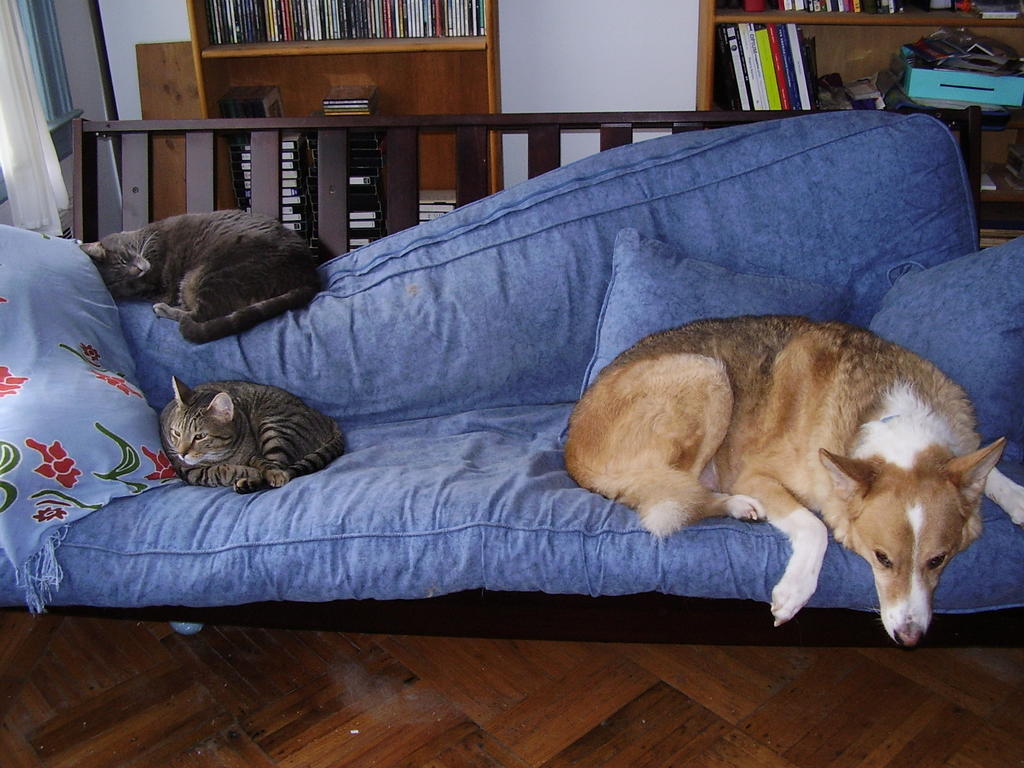
There's no contest here, the cat is that big. The couch is ruined. And it's not the first one: when the dog was a puppy, he used to take a running dive into our last couch, leaving an impact hole in its center. We've given up on regular upholstered furniture, opting instead for adirondack chairs and the like. Clockwise from top left: Boo Boo (aka Porkchop), Wilbur, and Angus (indoor brother of Vince).
Boo Boo, though obese, has gotten a clean bill of health from the vet. Go figure. Despite his girth, he does turn into Action Kitty when there are creatures to hunt. Or little brothers to boss around. Or dogs to box. I think it's part of his dominant nature, getting fat. (I wish I had the same excuse!)
Willie is shedding like crazy, in clumps and tufts, true to his collie-husky genes. The furniture is not the only receptacle for his fluffy residue. I showed up at work the other day covered in dog hair, garnering ridicule in the elevator. Leave it to me to wear black. I used FedEx labels to pull the hair off. (Free! Big!) My boss was helping me, peeling the hair off of my back, and said: "It's just like getting a wax!"
Tuesday, September 27, 2005
Jane Smiley on the 13 Ways
I just listened to WFMU's Speakeasy archive from last week, and you gotta check it out. Dorian Devins interviews Jane Smiley on her book, 13 WAYS OF LOOKING AT THE NOVEL, in which Smiley discusses her project of reading 100 novels. I think I need to do this. Hell, maybe I am doing this. Seems to have helped Smiley, and she and Dorian speak eloquently on the subject, on what the project did for Smiley's writing life, and on what the novel has done for our culture, for women in particular.
Here are links:
RealAudio archive version
MP3 Version
Dorian's archive
Dorian's blog
And Speakeasy is available for podcast too.
Here are links:
RealAudio archive version
MP3 Version
Dorian's archive
Dorian's blog
And Speakeasy is available for podcast too.
Sunday, September 25, 2005
More Homework: Kate Walbert and the “We” We Need
I’m glad I decided to persevere with Kate Walbert’s novel-in-stories, OUR KIND. I had been starting to overdose on the collective narrator thing. And Walbert’s opening story, “Intervention,” depicts a bunch of middle-aged, affluent women in love with their alcoholic real-estate agent. I worried that the book would be yet another example of Suburbia Lit, exploring the emotional bankruptcies and addictions of people-who-are-not-like-me. The problems of affluence are legitimate, certainly, but don’t always engage me.
What kept me reading, then sucked me in fully, is Walbert’s voice. Each sentence is a meandering musical path, each story an unpredictable, rerouting river. Her sense of comedy is akin to Lorrie Moore, that clever/giddy/quirky punch-in-gut feeling. But where Moore’s stories have a sharp sense of narrative control (to me, anyway), Walbert’s collection reads like a dream, or a wandering mind, or an unbridled memory.
Seems an odd choice to pair this kind of freeform story shape with the semi-gimmicky conceit of a collective narrator. But here’s why I think it works.
Backtrack a little: the collective narrator is a group of about ten women old enough to be my mother. Their kids have grown and moved away, their husbands have left or died. The women have lonely homes and time on their hands. So they turn to each other.
It sounds like a recipe for the gossipy viral thinking Tova Mirvis explores, or the proto-fascist groupthink Steven Millhauser suggests. But Walbert doesn’t go that way. Her narrator is more like a collective unconscious, and what glues these women together isn’t their passivity, or their conformity (not by a longshot), or their need to scapegoat problems. The glue is memory, of both shared experiences and individual ones reported back. The women band together out of necessity—to battle loneliness, to lend support, to pass time. But time itself is fluid in Walbert’s world, as are boundaries between selves.
Instead of exploring the darkness of “we,” Walbert plays with the other big thing that forges group identity: love.
Love. Damn. So simple, I wish I’d thought of it sooner in this discussion. Here is a “we” that requires no opposing “other.” Shared experiences of coming-of-age, motherhood, and death forge a bond much stronger—and perhaps even more interesting—than the lurking forces at work in the other stories I’ve examined. The cautionary tale is absent. Sure, there are layers of belonging in the group: some join later, some are the group's longtime core. But belonging itself (and its subtext—exclusion) is not the subject. Individually the women are flawed, but together, they form a heroine, in the traditional sense; they are a collective role model. And by ascribing this power to a group, rather than a shining individual, Walbert keeps the characters human and puts a novel spin on an old idea.
Walbert uses the same “we” mechanics as Tova Mirvis in THE LADIES AUXILIARY, and Jeffrey Eugenides in THE VIRGIN SUICIDES: the group is first person, but individuals are third person. It implies a spokesperson, but doesn’t identify one. I’m getting used to this convention and no longer find it distracting. Makes me wonder if early examples of first-person singular fiction were hard for their first readers to assimilate as well. But along with my growing familiarity comes a need for more: the “we” gimmick is not enough to keep me intrigued. And Walbert provides that needed thing with her manipulation of time.
The “now” of the stories is loose, flows freely into memory and back. One stark example of this technique is in “Come As You Were,” in which the gals have a goofy party in their old wedding gowns. Mixed in with the splitting seams and hilarity are snapshots of their younger sexual selves, some spoken, some thought, time going back and forth seamlessly. One of the women, Gay, remembers hiding in a hotel armoire on her wedding night, and her husband coaxing her out:
"I can do it,” she said.
"Great,” he said.
She was sixteen years old; she was twenty-two; she was fifty-three. It didn’t matter. She didn’t know a thing.
"I can do it,” she said.
And even in the midst of Gay’s memory is another, older one, a longing for her sister. The memory interrupts her first sex, throwing a wall between her and her husband.
She steps out of her high heels, out of the dress around her ankles; he is not a criminal. This he will say the next night, and the next. “I am not a criminal,” he will say. “This is legal, Gay,” he will say, articulating her name in the way one does the name of a child, or a particularly deaf relative when summoning patience.
Walbert organically tosses in the future tense, even as she throws time back. She doesn’t rely on space breaks and other flashback conventions to provide clarity. Clarity isn’t the goal. The meaning of a moment in time is enveloped in other moments.
A clue to this time-inside-time theme emerges in “Sick Chicks,” where the women sit in on a book club at a hospice. One of the friends, Judy, is among the dying. Another, Viv, has volunteered to lead the group. Viv gave up a promising academic career years ago. She has brought notes, and, her memory fresh from last month’s ULYSSES fiasco, is trying desperately to reign in a discussion of MRS DALLOWAY (another text playing with memory-in-now):
She looks at the group, then down at her notes. What has she written? What does it matter? On this page she’s copied, “This moment of June.” On this, “irony?” She can no longer recall what she intended to say, only the feeling of reading this book.
Viv has lost her academic chops, and her private regrets bleed in.
"This moment of June,” she says to fill in the silence, the incessant frothy dribbling of the fountain, the heat and smell of the Sunshine Room. She cannot bear this place, animals grazing on the lawn.
"Why ‘this moment’?”
"Is there any other?” says BeBe McShane, usually so quiet. The group turns to look at her.
"I think she means there’s no other than this. No future, no past. Only present.”
Viv is grateful for BeBe’s insight, but primarily because it focuses the discussion. Distracted by her own memories, she doesn’t quite get the meat of BeBe’s statement, but the collective unconscious has a clue. There aren’t any moments but this one, at the hospice, at the crossroads between nostalgia and death, having a chaotic discussion about something they all shared, the very book held in laps “like so many hymnals.”
Each of the moments in OUR KIND has the same kind of weight. Light, because it is only now; heavy, because now is full of other nows. And the collective narrator is the keeper of this knowledge, which is the source of its power.
What kept me reading, then sucked me in fully, is Walbert’s voice. Each sentence is a meandering musical path, each story an unpredictable, rerouting river. Her sense of comedy is akin to Lorrie Moore, that clever/giddy/quirky punch-in-gut feeling. But where Moore’s stories have a sharp sense of narrative control (to me, anyway), Walbert’s collection reads like a dream, or a wandering mind, or an unbridled memory.
Seems an odd choice to pair this kind of freeform story shape with the semi-gimmicky conceit of a collective narrator. But here’s why I think it works.
Backtrack a little: the collective narrator is a group of about ten women old enough to be my mother. Their kids have grown and moved away, their husbands have left or died. The women have lonely homes and time on their hands. So they turn to each other.
It sounds like a recipe for the gossipy viral thinking Tova Mirvis explores, or the proto-fascist groupthink Steven Millhauser suggests. But Walbert doesn’t go that way. Her narrator is more like a collective unconscious, and what glues these women together isn’t their passivity, or their conformity (not by a longshot), or their need to scapegoat problems. The glue is memory, of both shared experiences and individual ones reported back. The women band together out of necessity—to battle loneliness, to lend support, to pass time. But time itself is fluid in Walbert’s world, as are boundaries between selves.
Instead of exploring the darkness of “we,” Walbert plays with the other big thing that forges group identity: love.
Love. Damn. So simple, I wish I’d thought of it sooner in this discussion. Here is a “we” that requires no opposing “other.” Shared experiences of coming-of-age, motherhood, and death forge a bond much stronger—and perhaps even more interesting—than the lurking forces at work in the other stories I’ve examined. The cautionary tale is absent. Sure, there are layers of belonging in the group: some join later, some are the group's longtime core. But belonging itself (and its subtext—exclusion) is not the subject. Individually the women are flawed, but together, they form a heroine, in the traditional sense; they are a collective role model. And by ascribing this power to a group, rather than a shining individual, Walbert keeps the characters human and puts a novel spin on an old idea.
Walbert uses the same “we” mechanics as Tova Mirvis in THE LADIES AUXILIARY, and Jeffrey Eugenides in THE VIRGIN SUICIDES: the group is first person, but individuals are third person. It implies a spokesperson, but doesn’t identify one. I’m getting used to this convention and no longer find it distracting. Makes me wonder if early examples of first-person singular fiction were hard for their first readers to assimilate as well. But along with my growing familiarity comes a need for more: the “we” gimmick is not enough to keep me intrigued. And Walbert provides that needed thing with her manipulation of time.
The “now” of the stories is loose, flows freely into memory and back. One stark example of this technique is in “Come As You Were,” in which the gals have a goofy party in their old wedding gowns. Mixed in with the splitting seams and hilarity are snapshots of their younger sexual selves, some spoken, some thought, time going back and forth seamlessly. One of the women, Gay, remembers hiding in a hotel armoire on her wedding night, and her husband coaxing her out:
"I can do it,” she said.
"Great,” he said.
She was sixteen years old; she was twenty-two; she was fifty-three. It didn’t matter. She didn’t know a thing.
"I can do it,” she said.
And even in the midst of Gay’s memory is another, older one, a longing for her sister. The memory interrupts her first sex, throwing a wall between her and her husband.
She steps out of her high heels, out of the dress around her ankles; he is not a criminal. This he will say the next night, and the next. “I am not a criminal,” he will say. “This is legal, Gay,” he will say, articulating her name in the way one does the name of a child, or a particularly deaf relative when summoning patience.
Walbert organically tosses in the future tense, even as she throws time back. She doesn’t rely on space breaks and other flashback conventions to provide clarity. Clarity isn’t the goal. The meaning of a moment in time is enveloped in other moments.
A clue to this time-inside-time theme emerges in “Sick Chicks,” where the women sit in on a book club at a hospice. One of the friends, Judy, is among the dying. Another, Viv, has volunteered to lead the group. Viv gave up a promising academic career years ago. She has brought notes, and, her memory fresh from last month’s ULYSSES fiasco, is trying desperately to reign in a discussion of MRS DALLOWAY (another text playing with memory-in-now):
She looks at the group, then down at her notes. What has she written? What does it matter? On this page she’s copied, “This moment of June.” On this, “irony?” She can no longer recall what she intended to say, only the feeling of reading this book.
Viv has lost her academic chops, and her private regrets bleed in.
"This moment of June,” she says to fill in the silence, the incessant frothy dribbling of the fountain, the heat and smell of the Sunshine Room. She cannot bear this place, animals grazing on the lawn.
"Why ‘this moment’?”
"Is there any other?” says BeBe McShane, usually so quiet. The group turns to look at her.
"I think she means there’s no other than this. No future, no past. Only present.”
Viv is grateful for BeBe’s insight, but primarily because it focuses the discussion. Distracted by her own memories, she doesn’t quite get the meat of BeBe’s statement, but the collective unconscious has a clue. There aren’t any moments but this one, at the hospice, at the crossroads between nostalgia and death, having a chaotic discussion about something they all shared, the very book held in laps “like so many hymnals.”
Each of the moments in OUR KIND has the same kind of weight. Light, because it is only now; heavy, because now is full of other nows. And the collective narrator is the keeper of this knowledge, which is the source of its power.
Wednesday, September 21, 2005
"Only Writers Read Fiction." Urban Legend?
I aim to find out. Because I see a lot of books on laps in the subway every day. Many are fiction, and I recently noted the following titles on the 4/5 train (at great personal risk...over-shoulder reading is bad subway etiquette):
The Namesake, Jumpa Lahiri
The Upper Room, Mary Monroe
Afterburn, Zane (a whole lotta Zane on the train, I've noticed)
The Purification Ceremony, Mark T. Sullivan
The Fuck Up, Arthur Nersesian (Yippee! Go Arthur! Akashic edition too!)
Bel Canto, Ann Patchett (OK, that might have been me...)
Something Blue, Emily Griffin
A Clearing in the Distance : Frederick Law Olmsted and America in the 19th Century, Witold Rybczynski (not fiction, but wow! And the guy was riveted!)
Push, Sapphire (another common 5 train title)
These people can't all be writers. Can they? Or are there just that many of us (Oh God!)?
I'll try not to freak out (today, anyway) about the vast number of bibles, Koran, prayer books (for at least three religions), daily meditations, etc. They greatly outnumber the "literature" books. I'm just glad people are reading and keeping quiet so I can do the same. I also can't comment on the large number of books and newspapers in Russian, Chinese, Hebrew, Arabic, and Spanish around me. Again, I'm glad for the literacy, and the silence. I love watching kids read on the train. Some kids read nonfiction about animals and rockets. Others read the free AM New York and Metro newspapers. And of course, Harry Potter. It's all good. The nice thing, especially in the mornings, is that almost EVERYONE is reading. We say hello to each other, the ones I see every day, then open our books.
God, I love New York.
My unpredictable (in a good way) Russian dayjob colleague--let's call her "Scarlett Fever" to protect her identity--is an avid reader of women's fiction. I find the habits of her literary consumption most interesting. Here's an actual conversation we had today (as best I can remember) on the elevator:
ME: What are you reading? (She uses a cloth book cover, part embarrassment, part decoration.)
SCARLETT FEVER: Oh, some "thing." (Opens the book and shows me the title page.)
ME: Undead and Unwed? So like a vampire romance?
SCARLETT: I don't know yet, I just started it.
ME: Well, what did it say on the cover?
SCARLETT: I don't read the cover. I go by the picture. If it has a baby on it, those are good. And this kind of design, you can tell it is a comedy. (Shows me the cover, it has a cartoon of a cute blonde woman against a gothic sky, a goofy handwriting font.)
ME: So not the author, not the publisher, or the series, just the cover art?
SCARLETT: Just the design.
Which, as already observed, she obscures with a cloth cover. So it's not the appeal of the cover, per se, it's the existence of canned signifiers in the form of typeface and color choice, illustration style, and to a degree, pictorial subject. She's told me on other occasions, "If it has a baby on the cover, it's usually about a single dad and a babysitter. Those are tearjerkers."
(Sorry, Scarlett, if I'm butchering your witty repartee.)
Scarlett's literary commentary is designed to make me laugh, which satisfies a need I have, to stay sane in a given workday. But too, the "junk lit" satisfies a need she has, a legitimate one: immediate engagement and escape on her long bus ride home. She has read the English classics too, some in translation, some not, some in both languages. And has introduced me to English stuff too. How did I ever make it through college without knowing about the tragicomic genius of Jerome K Jerome?
And it goes without saying that her experience with Russian literature leaves me in the dust.
Before anyone chides Scarlett for "dumbing down" her literary consumption, I've noticed the books have given her an excellent grasp of conversational/colloquial English. What better way to learn to speak like a native than to read large quantities of pulp? Or, excuse me, "commercial fiction," since I firmly believe these writers work as hard on craft as the rest of us?
So here's my Exhibit A: Scarlett. A real live non-writer who reads fiction. Every single day.
Now I have to muster the courage to talk to that older guy I see on the train daily, reading literary fiction from the Brooklyn Public Library. And plowing through fast, from what I can tell. Is he a writer? A wannabe writer? A member of the "general public," whatever that is? Anyone care to take bets? Dare me?
The Namesake, Jumpa Lahiri
The Upper Room, Mary Monroe
Afterburn, Zane (a whole lotta Zane on the train, I've noticed)
The Purification Ceremony, Mark T. Sullivan
The Fuck Up, Arthur Nersesian (Yippee! Go Arthur! Akashic edition too!)
Bel Canto, Ann Patchett (OK, that might have been me...)
Something Blue, Emily Griffin
A Clearing in the Distance : Frederick Law Olmsted and America in the 19th Century, Witold Rybczynski (not fiction, but wow! And the guy was riveted!)
Push, Sapphire (another common 5 train title)
These people can't all be writers. Can they? Or are there just that many of us (Oh God!)?
I'll try not to freak out (today, anyway) about the vast number of bibles, Koran, prayer books (for at least three religions), daily meditations, etc. They greatly outnumber the "literature" books. I'm just glad people are reading and keeping quiet so I can do the same. I also can't comment on the large number of books and newspapers in Russian, Chinese, Hebrew, Arabic, and Spanish around me. Again, I'm glad for the literacy, and the silence. I love watching kids read on the train. Some kids read nonfiction about animals and rockets. Others read the free AM New York and Metro newspapers. And of course, Harry Potter. It's all good. The nice thing, especially in the mornings, is that almost EVERYONE is reading. We say hello to each other, the ones I see every day, then open our books.
God, I love New York.
My unpredictable (in a good way) Russian dayjob colleague--let's call her "Scarlett Fever" to protect her identity--is an avid reader of women's fiction. I find the habits of her literary consumption most interesting. Here's an actual conversation we had today (as best I can remember) on the elevator:
ME: What are you reading? (She uses a cloth book cover, part embarrassment, part decoration.)
SCARLETT FEVER: Oh, some "thing." (Opens the book and shows me the title page.)
ME: Undead and Unwed? So like a vampire romance?
SCARLETT: I don't know yet, I just started it.
ME: Well, what did it say on the cover?
SCARLETT: I don't read the cover. I go by the picture. If it has a baby on it, those are good. And this kind of design, you can tell it is a comedy. (Shows me the cover, it has a cartoon of a cute blonde woman against a gothic sky, a goofy handwriting font.)
ME: So not the author, not the publisher, or the series, just the cover art?
SCARLETT: Just the design.
Which, as already observed, she obscures with a cloth cover. So it's not the appeal of the cover, per se, it's the existence of canned signifiers in the form of typeface and color choice, illustration style, and to a degree, pictorial subject. She's told me on other occasions, "If it has a baby on the cover, it's usually about a single dad and a babysitter. Those are tearjerkers."
(Sorry, Scarlett, if I'm butchering your witty repartee.)
Scarlett's literary commentary is designed to make me laugh, which satisfies a need I have, to stay sane in a given workday. But too, the "junk lit" satisfies a need she has, a legitimate one: immediate engagement and escape on her long bus ride home. She has read the English classics too, some in translation, some not, some in both languages. And has introduced me to English stuff too. How did I ever make it through college without knowing about the tragicomic genius of Jerome K Jerome?
And it goes without saying that her experience with Russian literature leaves me in the dust.
Before anyone chides Scarlett for "dumbing down" her literary consumption, I've noticed the books have given her an excellent grasp of conversational/colloquial English. What better way to learn to speak like a native than to read large quantities of pulp? Or, excuse me, "commercial fiction," since I firmly believe these writers work as hard on craft as the rest of us?
So here's my Exhibit A: Scarlett. A real live non-writer who reads fiction. Every single day.
Now I have to muster the courage to talk to that older guy I see on the train daily, reading literary fiction from the Brooklyn Public Library. And plowing through fast, from what I can tell. Is he a writer? A wannabe writer? A member of the "general public," whatever that is? Anyone care to take bets? Dare me?
Subscribe to:
Posts (Atom)