Via Ed Champion again, Jennifer Weiner responds to those who claim genre fiction is inferior:
Doesn’t it mean that the Apocalypse is coming if their gaze wavers for even an instant from the MFA-holding, quarterly-publishing, Park-Slope-dwelling literary wonders of the moment to discuss the books that the “less-educated basic readers” actually read, discuss and enjoy?
I love the way Weiner champions genre fiction, not just on her blog, but in the press, and consistently. Her argument: people who declaim chick lit are just misogynists in drag. She makes me want to like chick lit, on principle. I wanna be of the people, maybe. Today, anyway.
Thursday, March 08, 2007

Thursday, March 01, 2007
Another Book Trailer...Girlbomb!
My friend Janice has her paperback for Girlbomb: A Halfway Homeless Memoir coming out next week. And here's the trailer! Congrats, Janice, on both.
I recommended the memoir highly last year when the hardback came out, and I still do. It's about an adolescence spent in and out of teen shelters in NYC. Janice's voice is crisp and funny, and she has a keen sense of pacing. It's a portrait of an era, a place, and a quirky, interesting individual coming into her own.
What is "home?" Where can a girl feel safe? What are nuns really like? Read and learn.
While We're on the Subject of the "And Then"
Or plot, if you're still calling it that... a couple more opinions from the field.
1.
Ed Champion's interview with Heidi Julavits on the Bat Segundo Show is worth a listen. He asks her view on “closure.” She says genre fiction operates on the “what happened” level, and when you find out what happened, “you don’t really have any more curiosity about it.” It’s “all about information.”
But she argues you can have informational closure without intellectual and emotional closure. She likes this kind of ambiguity. “I’ve run up against a lot of cultural resistance to ambiguity,” she says. She talks about book reviewers too: “They hate books with 'style.' That’s the new thing.”
And Ed Champion, he dishes out confrontational questions, as usual, like “How much ambiguity is too much?” and, “What steps do you take to justify ambiguity?”
I won’t transcribe it, but do listen. Unless you are uncomfortable listening to confrontational questions. Does ambiguity require justification in fiction? You decide.
2.
Check out David Denby's essay, "The New Disorder," in the recent New Yorker. The subject is fractured/nonlinear storytelling in film, from "Pulp Fiction" to "Memento" to "Babel" to much older precedents in print and on the stage. I was cracking up at this, in reference to the most recent crop:
Some of the directors may be just playing with us or, perhaps, acting out their boredom with that Hollywood script-conference menace the conventional "story arc." But others may be trying to jolt us into a new understanding of art, or even a new understanding of life.
Trying to jolt, yes! I disagree on the notion of attempted novelty. Most artists have made their peace with the originality issue. But bigger question--does the jolt succeed in giving understanding, new or not? Some of Denby's conclusion rings true to me--he recognizes these approaches as legitimate play, with noble goals. But when the work becomes a "closed form," or "puzzle box," "the rich ambivalence of art somehow slips away." Modern audiences have become more tolerant of, even demanding of, this mashup/puzzle paradigm. But does it move them? Is that even the goal?
Anyhoo, I'm not too worried about linear vs. nonlinear storytelling. My issues are about singular/central conflict vs. multiple/scattered conflict. But ambiguity, yes. How do you make it good?
At a writer's conference I went to a couple years ago, an editor polled the crowd: how many preferred a fractured and confusing narrative and how many preferred a clear and linear one? The answer surprised me: it was about half and half. He said that was the response he expected.
1.
Ed Champion's interview with Heidi Julavits on the Bat Segundo Show is worth a listen. He asks her view on “closure.” She says genre fiction operates on the “what happened” level, and when you find out what happened, “you don’t really have any more curiosity about it.” It’s “all about information.”
But she argues you can have informational closure without intellectual and emotional closure. She likes this kind of ambiguity. “I’ve run up against a lot of cultural resistance to ambiguity,” she says. She talks about book reviewers too: “They hate books with 'style.' That’s the new thing.”
And Ed Champion, he dishes out confrontational questions, as usual, like “How much ambiguity is too much?” and, “What steps do you take to justify ambiguity?”
I won’t transcribe it, but do listen. Unless you are uncomfortable listening to confrontational questions. Does ambiguity require justification in fiction? You decide.
2.
Check out David Denby's essay, "The New Disorder," in the recent New Yorker. The subject is fractured/nonlinear storytelling in film, from "Pulp Fiction" to "Memento" to "Babel" to much older precedents in print and on the stage. I was cracking up at this, in reference to the most recent crop:
Some of the directors may be just playing with us or, perhaps, acting out their boredom with that Hollywood script-conference menace the conventional "story arc." But others may be trying to jolt us into a new understanding of art, or even a new understanding of life.
Trying to jolt, yes! I disagree on the notion of attempted novelty. Most artists have made their peace with the originality issue. But bigger question--does the jolt succeed in giving understanding, new or not? Some of Denby's conclusion rings true to me--he recognizes these approaches as legitimate play, with noble goals. But when the work becomes a "closed form," or "puzzle box," "the rich ambivalence of art somehow slips away." Modern audiences have become more tolerant of, even demanding of, this mashup/puzzle paradigm. But does it move them? Is that even the goal?
Anyhoo, I'm not too worried about linear vs. nonlinear storytelling. My issues are about singular/central conflict vs. multiple/scattered conflict. But ambiguity, yes. How do you make it good?
At a writer's conference I went to a couple years ago, an editor polled the crowd: how many preferred a fractured and confusing narrative and how many preferred a clear and linear one? The answer surprised me: it was about half and half. He said that was the response he expected.
Friday, February 23, 2007
A New Use for Spam
Folks, a recent letter about Cialis from one Junior Maxwell gave me a brain fart. Much has been said about the random language poetry of spam, but what about the sender's names? I sometimes beat my head against the desk trying to think of the perfect names for my fictional characters. But I have a beautiful source, right under my nose. My spam folder! Why look in the phone book? When life gives you spam, make spaminade!
Here are a few choice monikers from a recent delete session: Earline Nix! Dewitt Trotter! Jeremiah Hill! Darlene Flood! Heriberto Griggs! Jewell Estes! Lenora Brewster! Robin Flowers! Hector Ash! Elmo King!
My imagination has no problem picturing these people, who probably never intended to send me mail. Lenora Brewster is a church lady. She has never been married, and doesn't fully want to, speaks in tongues, and loves praising the Lord. Dewitt Trotter is a greying white guy who wears only red ties and has no idea his daughter is dating Heriberto Griggs. Hector Ash is a computer programmer who comments his code with silly secret notes to his colleagues, like, 'wish we were in Hawaii, but we're not. How soon is lunch?' Darlene Flood has been struggling with weight her whole life, and is now trying South Beach for the first time. The divorce has been helping. Elmo King sells used cars in Texas, but dreams of becoming a full-time magician. Robin Flowers is a porn actress, of course, and is considering another surgical enhancement. Earline Nix is a psychic, and her son in law, Jeremiah Hill, thinks she should be put away. And Jewell Estes is a photojournalist, naturally.
Are they Googling themselves into this blog post? If so, I apologize to the folks above. But that won't keep me from using their names.
Thank you, spammers! You will now be committed to the realm of fiction.
Here are a few choice monikers from a recent delete session: Earline Nix! Dewitt Trotter! Jeremiah Hill! Darlene Flood! Heriberto Griggs! Jewell Estes! Lenora Brewster! Robin Flowers! Hector Ash! Elmo King!
My imagination has no problem picturing these people, who probably never intended to send me mail. Lenora Brewster is a church lady. She has never been married, and doesn't fully want to, speaks in tongues, and loves praising the Lord. Dewitt Trotter is a greying white guy who wears only red ties and has no idea his daughter is dating Heriberto Griggs. Hector Ash is a computer programmer who comments his code with silly secret notes to his colleagues, like, 'wish we were in Hawaii, but we're not. How soon is lunch?' Darlene Flood has been struggling with weight her whole life, and is now trying South Beach for the first time. The divorce has been helping. Elmo King sells used cars in Texas, but dreams of becoming a full-time magician. Robin Flowers is a porn actress, of course, and is considering another surgical enhancement. Earline Nix is a psychic, and her son in law, Jeremiah Hill, thinks she should be put away. And Jewell Estes is a photojournalist, naturally.
Are they Googling themselves into this blog post? If so, I apologize to the folks above. But that won't keep me from using their names.
Thank you, spammers! You will now be committed to the realm of fiction.
Thursday, February 15, 2007
The Tyranny of Plot: A Rantlet (And I'll Probably Have to Take It Back Later)
Why do fiction writers love to talk about plot so much? Maybe because it can be the hardest thing to master, especially in longer works? Or maybe, because it’s fairly easy to identify patterns in classic plots, and conform to them?
Why is it that any discussion of plot makes me itchy, and not in a good way? Could it be because it’s my weakness? Could it be the word plot itself? Terrorists and saboteurs have plots. Why must I? Plots thicken. What if I prefer airiness to thickness? Plots have climaxes. What if you’re faking your climaxes (which many storytellers are guilty of, in my opinion)? What if real life doesn’t have climaxes? Does this mean stories aren’t actually connected to real life? What a depressing thought.
The reason I read and write fiction is to explore human feelings and experience, and to discover things I wouldn’t in my day-to-day. And to me, one of the most important human feelings is inertia. Depicting inertia is something I’m struggling with in one of my almost-done-but-not-quite-there stories, which, to make myself laugh, I titled “The Plot,” because it doesn’t exactly have one.
It’s about a garden plot, which I’d like to think is a better way to think about story plot. The protag is restless and a little lost after her youngest child goes to college, and she kills time in her community garden plot, where she cultivates stuff, but where weeds crop up too--she pushes them back; they broadcast their own seeds here and there. Maybe this is my kind of story plot. Plant a few seeds in the first page, then see what sprouts, and how it looks, and what takes over the yard. Seeds are natural containers of suspense. Maybe tying up loose ends isn’t necessary. Maybe “endings” are overrated. Gardens don’t end, after all. The flora and fauna keep things going, even when human characters stop making those “critical choices” we writers love to dissect.
Am I being a “passive” writer, resisting endings? Do my characters have no agency then? Are they more passive than me? Is this a cop-out? Is it possible to satisfy readers without endings? Is satisfaction even the right goal?
OR, is it important for us to resist the tyranny of our expectation of plot? Like resisting the idea that Jesus is Lord? Which He is, for some people (and I’m happy for them), but not me, any more? It’s the same kind of thing, resisting indoctrination. The war is inside yourself. It’s my own thought habits I’m challenging here. I’m trying to figure out my truth. Is this making any sense? Am I foaming at the mouth yet?
If you’re still with me, and feel any glimmer of recognition at my questions, I heartily recommend Liesl Schwabe’s piece in the February 2007 issue of AWP’s Writer’s Chronicle. The essay, entitled, “Leaving the Window Open: Refusing Closure and Avoiding an Arc in Nonfiction Writing,” is aimed at reportage, but equally applicable to realist fiction, in my view. Here’s where I started going nuts with my highlighter:
Nonfiction writing that refuses to tidy up the mess on the page can often force the reader into a very active place of considering the information, not in the way that we collect headlines and trivia, but in triggering an awareness of interdependency, be it of politics or history or memory, that necessarily locates the reader within the mystery and blessing of his or her own humanity. When this kind of responsibility manifests in some prickly combination of acceptance and discomfort, I feel it ultimately represents a much more accurate way to share and keep track of experience.
Amen, sister. She makes me want to write complicated, open-ended things, or maybe I wanted that already and she just named it. Schwabe uses the metaphor of architecture to discuss structure, instead of “arc,” that is to say, stories benefit from having some kind of internal logic holding them together. But they need not have the focus on forward movement and results/outcome/conclusion that we’ve been brainwashed to hold valuable.
Endings, arcs, the crap in Wikipedia’s definition of “plot,” these things do work on me. They keep me inert in front of the television, they keep me up all night reading certain bestselling books. But characters-serving-plot makes my eyes bloodshot from lack of sleep, not deep emotion. And racing through a book doesn’t necessarily mean the book is good. Perfectly crafted stories sometimes leave me cold. Loosely crafted stories sometimes stick with me, even haunt me, if the characters and emotions ring true.
I’m reminded of Rick Moody’s talk with Michael Silverblatt, in which he holds his nose at the “stench of fiction.” The stench can be perfumey too, maybe even seductive. But a smell is a smell. I prefer natural smells over artificial ones--today, anyway.
Why is it that any discussion of plot makes me itchy, and not in a good way? Could it be because it’s my weakness? Could it be the word plot itself? Terrorists and saboteurs have plots. Why must I? Plots thicken. What if I prefer airiness to thickness? Plots have climaxes. What if you’re faking your climaxes (which many storytellers are guilty of, in my opinion)? What if real life doesn’t have climaxes? Does this mean stories aren’t actually connected to real life? What a depressing thought.
The reason I read and write fiction is to explore human feelings and experience, and to discover things I wouldn’t in my day-to-day. And to me, one of the most important human feelings is inertia. Depicting inertia is something I’m struggling with in one of my almost-done-but-not-quite-there stories, which, to make myself laugh, I titled “The Plot,” because it doesn’t exactly have one.
It’s about a garden plot, which I’d like to think is a better way to think about story plot. The protag is restless and a little lost after her youngest child goes to college, and she kills time in her community garden plot, where she cultivates stuff, but where weeds crop up too--she pushes them back; they broadcast their own seeds here and there. Maybe this is my kind of story plot. Plant a few seeds in the first page, then see what sprouts, and how it looks, and what takes over the yard. Seeds are natural containers of suspense. Maybe tying up loose ends isn’t necessary. Maybe “endings” are overrated. Gardens don’t end, after all. The flora and fauna keep things going, even when human characters stop making those “critical choices” we writers love to dissect.
Am I being a “passive” writer, resisting endings? Do my characters have no agency then? Are they more passive than me? Is this a cop-out? Is it possible to satisfy readers without endings? Is satisfaction even the right goal?
OR, is it important for us to resist the tyranny of our expectation of plot? Like resisting the idea that Jesus is Lord? Which He is, for some people (and I’m happy for them), but not me, any more? It’s the same kind of thing, resisting indoctrination. The war is inside yourself. It’s my own thought habits I’m challenging here. I’m trying to figure out my truth. Is this making any sense? Am I foaming at the mouth yet?
If you’re still with me, and feel any glimmer of recognition at my questions, I heartily recommend Liesl Schwabe’s piece in the February 2007 issue of AWP’s Writer’s Chronicle. The essay, entitled, “Leaving the Window Open: Refusing Closure and Avoiding an Arc in Nonfiction Writing,” is aimed at reportage, but equally applicable to realist fiction, in my view. Here’s where I started going nuts with my highlighter:
Nonfiction writing that refuses to tidy up the mess on the page can often force the reader into a very active place of considering the information, not in the way that we collect headlines and trivia, but in triggering an awareness of interdependency, be it of politics or history or memory, that necessarily locates the reader within the mystery and blessing of his or her own humanity. When this kind of responsibility manifests in some prickly combination of acceptance and discomfort, I feel it ultimately represents a much more accurate way to share and keep track of experience.
Amen, sister. She makes me want to write complicated, open-ended things, or maybe I wanted that already and she just named it. Schwabe uses the metaphor of architecture to discuss structure, instead of “arc,” that is to say, stories benefit from having some kind of internal logic holding them together. But they need not have the focus on forward movement and results/outcome/conclusion that we’ve been brainwashed to hold valuable.
Endings, arcs, the crap in Wikipedia’s definition of “plot,” these things do work on me. They keep me inert in front of the television, they keep me up all night reading certain bestselling books. But characters-serving-plot makes my eyes bloodshot from lack of sleep, not deep emotion. And racing through a book doesn’t necessarily mean the book is good. Perfectly crafted stories sometimes leave me cold. Loosely crafted stories sometimes stick with me, even haunt me, if the characters and emotions ring true.
I’m reminded of Rick Moody’s talk with Michael Silverblatt, in which he holds his nose at the “stench of fiction.” The stench can be perfumey too, maybe even seductive. But a smell is a smell. I prefer natural smells over artificial ones--today, anyway.
Wednesday, February 07, 2007
I Loved "A Spanish Play," I Don’t Care What Anyone Says
I’m glad I decided to delay judgment on Yasmina Reza’s A Spanish Play, currently up at NYC’s Classic Stage Company. I had a funny encounter with the subscribers sitting behind me—one man joked about leaving an aisle free for exiting. “I heard that!” I said, with playful self-righteousness. The woman with the man (who was a generation older than me, and probably an actress herself) suddenly started swearing a blue streak—“Fuck that Charles Isherwood!” “Well, I’m gonna judge it for myself,” I countered. She agreed. And we defiant theatergoers took our seats in the small thrust auditorium.
So, the consensus among reviewers seems be this: great actors transcending bad material. I agree, the actors were engaging, impressive veterans who were more than watchable. Since I'm with the reviewers on this point, I won’t dwell on the performances, but instead, I’ll put up a counterargument on the play itself. Maybe I just don’t see enough theater to be as jaded as everyone else, but I left the play wishing I had a copy of the script to read.
Why do people hate meta so much? Why do American audiences find it pretentious and gimmicky? Why all the bitching about its lack of originality? Who says deconstruction is trying to be “original?” Why do we need so badly to be taken for a superrealist ride? Why can’t we be more French? Or at least Canadian?
The play, translated from the French by David Ives, does not take itself too seriously, in my opinion, which is precisely what makes meta work, for me, when it does. Other reviewers claim the actors made unfunny lines funny, but I disagree. I would probably laugh at it on the page too.
The story’s main conceit is that we are watching a rehearsal of a Spanish play, a comedy, in which two of the characters are themselves actresses, one far more successful than the other. The less-successful one (played by the breathtaking Linda Emond) is rehearsing another play, a Bulgarian drama, throughout the Spanish play. Meanwhile, all cast members pause periodically to address a live videocam, projected on the back wall, with ruminations on their process, its irritants, and how it fucks with their identities.
Maybe the problem for we Americans is that when we see characters who are themselves actors, we want to have the laughs at their expense. Actors are only acceptable subject matter if we can make fun of their narcissism. Reza’s choice was to explore this tendency, but not fully buy into it. The result can be audiences flippantly saying, “good for actors, bad for everyone else.” I, for one, am glad Reza took this risk.
But I’m one non-actor who has grown interested in the actor’s process. I’ve decided they’re easy targets. I spent years believing the popular notion that actors are simply hungry for attention, nothing more. But conversations with actors, some novel-writing-research at HB Studios, and reading a few acting books has changed my tune. Acting, like fiction writing, is a highly moral activity. The morality comes from exploring other selves, finding common ground, practicing compassion and mercy. I think the world is hard on actors, especially fictional ones, even as we spend a good deal of our time watching the fruits of their labor.
The big crowd-pleasing moment of the play comes when the more successful actress character, Nuria, played by poised Katherine Borowitz, tries on two ridiculously slutty dresses she might wear to a red carpet. Crowd-pleasing, because insecure actors are such easy targets. But Reza is not fully laughing with us. It's her Spanish playwright's comedy, not hers. And when Borowitz steps down from her platform character-shoes to discuss the actor's process, the cruelty inside the cheap laughs (which I partook in) becomes subject matter. I was left with a tender view of artists and their efforts, the struggle to make "real" out of the artificial.
My favorite moment in the play is when Aurelia, Linda Emond’s character, is running lines for the Bulgarian play with her half-cooperative husband (played by engaging physical-comic Denis O’Hare). She does the same monologue twice. The first time, it’s easy to miss the nuance of the text, but the second time through, it carries more weight. This is definitely a case of actress transcending material—the actress Aurelia transcending the material of the Bulgarian play, fleshing it out through repetition, finding its value. And, though Emond’s execution is exquisite, credit for this repetition belongs to the playwrights, both the fictional Spanish one and Reza herself.
My brother, an actor, loved this scene too. “That’s the kind of thing you see in acting class,” he said on the ride home. A moment when, through practice, the text just clicks into place, becomes poetry before your eyes. It’s nice to be there when it happens.
(P.S....I'm not the only contrarian out there...)
So, the consensus among reviewers seems be this: great actors transcending bad material. I agree, the actors were engaging, impressive veterans who were more than watchable. Since I'm with the reviewers on this point, I won’t dwell on the performances, but instead, I’ll put up a counterargument on the play itself. Maybe I just don’t see enough theater to be as jaded as everyone else, but I left the play wishing I had a copy of the script to read.
Why do people hate meta so much? Why do American audiences find it pretentious and gimmicky? Why all the bitching about its lack of originality? Who says deconstruction is trying to be “original?” Why do we need so badly to be taken for a superrealist ride? Why can’t we be more French? Or at least Canadian?
The play, translated from the French by David Ives, does not take itself too seriously, in my opinion, which is precisely what makes meta work, for me, when it does. Other reviewers claim the actors made unfunny lines funny, but I disagree. I would probably laugh at it on the page too.
The story’s main conceit is that we are watching a rehearsal of a Spanish play, a comedy, in which two of the characters are themselves actresses, one far more successful than the other. The less-successful one (played by the breathtaking Linda Emond) is rehearsing another play, a Bulgarian drama, throughout the Spanish play. Meanwhile, all cast members pause periodically to address a live videocam, projected on the back wall, with ruminations on their process, its irritants, and how it fucks with their identities.
Maybe the problem for we Americans is that when we see characters who are themselves actors, we want to have the laughs at their expense. Actors are only acceptable subject matter if we can make fun of their narcissism. Reza’s choice was to explore this tendency, but not fully buy into it. The result can be audiences flippantly saying, “good for actors, bad for everyone else.” I, for one, am glad Reza took this risk.
But I’m one non-actor who has grown interested in the actor’s process. I’ve decided they’re easy targets. I spent years believing the popular notion that actors are simply hungry for attention, nothing more. But conversations with actors, some novel-writing-research at HB Studios, and reading a few acting books has changed my tune. Acting, like fiction writing, is a highly moral activity. The morality comes from exploring other selves, finding common ground, practicing compassion and mercy. I think the world is hard on actors, especially fictional ones, even as we spend a good deal of our time watching the fruits of their labor.
The big crowd-pleasing moment of the play comes when the more successful actress character, Nuria, played by poised Katherine Borowitz, tries on two ridiculously slutty dresses she might wear to a red carpet. Crowd-pleasing, because insecure actors are such easy targets. But Reza is not fully laughing with us. It's her Spanish playwright's comedy, not hers. And when Borowitz steps down from her platform character-shoes to discuss the actor's process, the cruelty inside the cheap laughs (which I partook in) becomes subject matter. I was left with a tender view of artists and their efforts, the struggle to make "real" out of the artificial.
My favorite moment in the play is when Aurelia, Linda Emond’s character, is running lines for the Bulgarian play with her half-cooperative husband (played by engaging physical-comic Denis O’Hare). She does the same monologue twice. The first time, it’s easy to miss the nuance of the text, but the second time through, it carries more weight. This is definitely a case of actress transcending material—the actress Aurelia transcending the material of the Bulgarian play, fleshing it out through repetition, finding its value. And, though Emond’s execution is exquisite, credit for this repetition belongs to the playwrights, both the fictional Spanish one and Reza herself.
My brother, an actor, loved this scene too. “That’s the kind of thing you see in acting class,” he said on the ride home. A moment when, through practice, the text just clicks into place, becomes poetry before your eyes. It’s nice to be there when it happens.
(P.S....I'm not the only contrarian out there...)
Friday, January 26, 2007
More Happenings
Everyone is happening this month...I hope I can get to some of this but day job is interfering. Still, I can shoutout, no?
Tonight Mad Hatter's Review is having their Friday night reading at KGB, featuring Norman Lock, Terese Svoboda, and Deb Olin Unferth. They know how to lasso the talent for these things. For info click the link and scroll down.
Next Wednesday January 31 8PM, Poetry vs. Comedy (PVC) will greet the new year at a new venue, the Bowery Poetry Club. It's a super-fun event, way better than American Idol! Poets alternate with comedians in 8 minute sets, followed by an improvisational showdown to determine the winner. Judges provide commentary, and host Carolyn Castiglia provides jabs and laughs. This month's performers are Brandy Barber, Michelle Buteau, Luke Thayer, Shane Luitjens, Zaedryn Meade, Thad Rutkowski, and Pindeldyboz as musical guest (I've heard they're hilarious.)
Next Thursday, February 1, Virginia Vitzthum's book, I LOVE YOU, LET'S MEET, officially launches! Adam's Books in Park Slope, 8:00PM.
Next Friday, February 2, my troubador friend John Kessel is playing Hank's Saloon (I believe this is Hank's in Brooklyn--dont' know of others). Check out his song, "Thrown Away," on his Myspace page. I love this song.
Probably just the tip of the iceberg.
And because I'm all over the place today, here's a crappy video of our dog Willie taking his medicine. Crappy because the sound got out of sync. I have a lot to learn.
Tonight Mad Hatter's Review is having their Friday night reading at KGB, featuring Norman Lock, Terese Svoboda, and Deb Olin Unferth. They know how to lasso the talent for these things. For info click the link and scroll down.
Next Wednesday January 31 8PM, Poetry vs. Comedy (PVC) will greet the new year at a new venue, the Bowery Poetry Club. It's a super-fun event, way better than American Idol! Poets alternate with comedians in 8 minute sets, followed by an improvisational showdown to determine the winner. Judges provide commentary, and host Carolyn Castiglia provides jabs and laughs. This month's performers are Brandy Barber, Michelle Buteau, Luke Thayer, Shane Luitjens, Zaedryn Meade, Thad Rutkowski, and Pindeldyboz as musical guest (I've heard they're hilarious.)
Next Thursday, February 1, Virginia Vitzthum's book, I LOVE YOU, LET'S MEET, officially launches! Adam's Books in Park Slope, 8:00PM.
Next Friday, February 2, my troubador friend John Kessel is playing Hank's Saloon (I believe this is Hank's in Brooklyn--dont' know of others). Check out his song, "Thrown Away," on his Myspace page. I love this song.
Probably just the tip of the iceberg.
And because I'm all over the place today, here's a crappy video of our dog Willie taking his medicine. Crappy because the sound got out of sync. I have a lot to learn.
Sunday, January 21, 2007
I Love You, Let's Meet: The Musical
Check out the trailer my write-club cronie Virginia Vitzthum did (with some very talented friends), for her new book, I LOVE YOU, LET'S MEET: ADVENTURES IN ONLINE DATING. It features cats! And a ukulelist!
Book trailers, who'd'a thunk it? I had the opportunity to read this book as it was coming to life, and it's riveting. I don't date any more (except going to the movies with my sweet hubby), and boy, times have changed. She dissects the primary conundrum of dating in the internet age--what happens when you fall in love with someone's writing, but it's not the same in real life? How does one use the resource of the internet to find compatible people, when there are too many people to choose from? Is it like shopping for humans? When does the shopping end? But too, is it good to be able to ask for what you really want? And isn't it nice to be able to craft a profile, and put art into how you put yourself out there?
I can't wait to read the finished book. Hope you enjoy the musical version.
Book trailers, who'd'a thunk it? I had the opportunity to read this book as it was coming to life, and it's riveting. I don't date any more (except going to the movies with my sweet hubby), and boy, times have changed. She dissects the primary conundrum of dating in the internet age--what happens when you fall in love with someone's writing, but it's not the same in real life? How does one use the resource of the internet to find compatible people, when there are too many people to choose from? Is it like shopping for humans? When does the shopping end? But too, is it good to be able to ask for what you really want? And isn't it nice to be able to craft a profile, and put art into how you put yourself out there?
I can't wait to read the finished book. Hope you enjoy the musical version.
Thursday, January 18, 2007
I'm Reading This Sunday at Pheonix Series
Haven't decided, but I may bust out the ukulele for this one. Carol's a fellow cat person, and I do write songs about cats. And Rob appears to be a dog person, and I do write songs about dogs. Plus there's the song about the flying lion, but I can't worry too much about common ground there.
If you come, bring your stuff for the open mic!
THE PHOENIX READING SERIES @ HIGH CHAI
18 Ave B (between 1st & 2nd)
212-477-2424
Sunday, January 21, 2007 2pm
Carol Novack is a long lapsed criminal defense/constitutional lawyer. Her writings can and will be found in many publications, including The Penguin Book of Australian Women Poets, American Letters & Commentary, Anemone Sidecar, Big Bridge, BlazeVOX, Del Sol Review, Diagram, First Intensity, 5_Trope, La Petite Zine, LIT, Milk, Notre Dame Review, Salt River Review, and Word Riot. Carol publishes and edits the offbeat e-journal Mad Hatters' Review, teaches innovative fiction writing at The Women's Studio Center, curates a reading series at the KGB Bar, and writes a humorous advice column for City Scoops under the nom Loopy Lulu.
Anne Elliott 's poetry has been featured in anthologies including Aloud: Voices from the Nuyorican Poets' Cafe, Poetry Nation: the North American Anthology of Fusion Poetry, and Verses that Hurt: Pleasure and Pain from the Poemfone Poets. She has performed (with and without ukulele) at the Whitney Museum, PS122, Dixon Place, St. Mark's Poetry Project, and others. Her short fiction has appeared in Hobart and Pindeldyboz, and she currently seeks a home for her novel, Starving Hysterical Naked. She blogs on the writing life and feral cat management at http://assbackwords.blogspot.com.
Rob Stephenson is NYC based writer, composer, and visual artist. His writings have appeared in print and online in such publications as Entangled Lives, Skin and Ink, Blithe House Quarterly, Velvet Mafia, Dangerous Families, Problem Child, Best Bisexual Erotica, and Perspectives on Evil and Human Wickedness; writings will also emerge shortly in Issue 7 of Mad Hatters' Review. Rob Stephenson's first novel is forthcoming from Suspect Thoughts Press. His drawings have been exhibited at the Intersection Art Gallery in San Francisco, the Headlands Center for the Arts, the Katona Museum, and the Wexner Center for the Arts. His experimental music CD "dog" composed with Mikael Karlsson is now out on Please MusicWorks. Visit www.dog-cd.com.
OPEN READING FOLLOWS—AS TIME ALLOWS
One Purchase & Donation
If you come, bring your stuff for the open mic!
THE PHOENIX READING SERIES @ HIGH CHAI
18 Ave B (between 1st & 2nd)
212-477-2424
Sunday, January 21, 2007 2pm
Carol Novack is a long lapsed criminal defense/constitutional lawyer. Her writings can and will be found in many publications, including The Penguin Book of Australian Women Poets, American Letters & Commentary, Anemone Sidecar, Big Bridge, BlazeVOX, Del Sol Review, Diagram, First Intensity, 5_Trope, La Petite Zine, LIT, Milk, Notre Dame Review, Salt River Review, and Word Riot. Carol publishes and edits the offbeat e-journal Mad Hatters' Review, teaches innovative fiction writing at The Women's Studio Center, curates a reading series at the KGB Bar, and writes a humorous advice column for City Scoops under the nom Loopy Lulu.
Anne Elliott 's poetry has been featured in anthologies including Aloud: Voices from the Nuyorican Poets' Cafe, Poetry Nation: the North American Anthology of Fusion Poetry, and Verses that Hurt: Pleasure and Pain from the Poemfone Poets. She has performed (with and without ukulele) at the Whitney Museum, PS122, Dixon Place, St. Mark's Poetry Project, and others. Her short fiction has appeared in Hobart and Pindeldyboz, and she currently seeks a home for her novel, Starving Hysterical Naked. She blogs on the writing life and feral cat management at http://assbackwords.blogspot.com.
Rob Stephenson is NYC based writer, composer, and visual artist. His writings have appeared in print and online in such publications as Entangled Lives, Skin and Ink, Blithe House Quarterly, Velvet Mafia, Dangerous Families, Problem Child, Best Bisexual Erotica, and Perspectives on Evil and Human Wickedness; writings will also emerge shortly in Issue 7 of Mad Hatters' Review. Rob Stephenson's first novel is forthcoming from Suspect Thoughts Press. His drawings have been exhibited at the Intersection Art Gallery in San Francisco, the Headlands Center for the Arts, the Katona Museum, and the Wexner Center for the Arts. His experimental music CD "dog" composed with Mikael Karlsson is now out on Please MusicWorks. Visit www.dog-cd.com.
OPEN READING FOLLOWS—AS TIME ALLOWS
One Purchase & Donation
Sunday, January 07, 2007
Greetings from the Cute Farm
 Sometimes I fear this sweetness will plunge me into a diabetic coma. Here's Angus playing with his new Christmas toy.
And here's a boy's Nap Club struggling to keep eyes open on the sofa.

I don't really have anything better to blog about. I've been writing every day, working on the new novel, ALMA, submitting stories, and applying for this and that residency, etc. I've been really enjoying the research aspect of the novel, looking at books about the theater, also spiritual stuff from AA and the Episcopal church. I'm not a believer in God, but I do find reading about it interesting, and it is proving to be the main theme of my novel, not God, but rather the absence of God, or what happens internally when one loses faith and feels like she is in the minority.
So, back to work I go. Hope you all are enjoying the new year so far. I am!
Saturday, December 30, 2006
Wilbur's Christmas Hangover
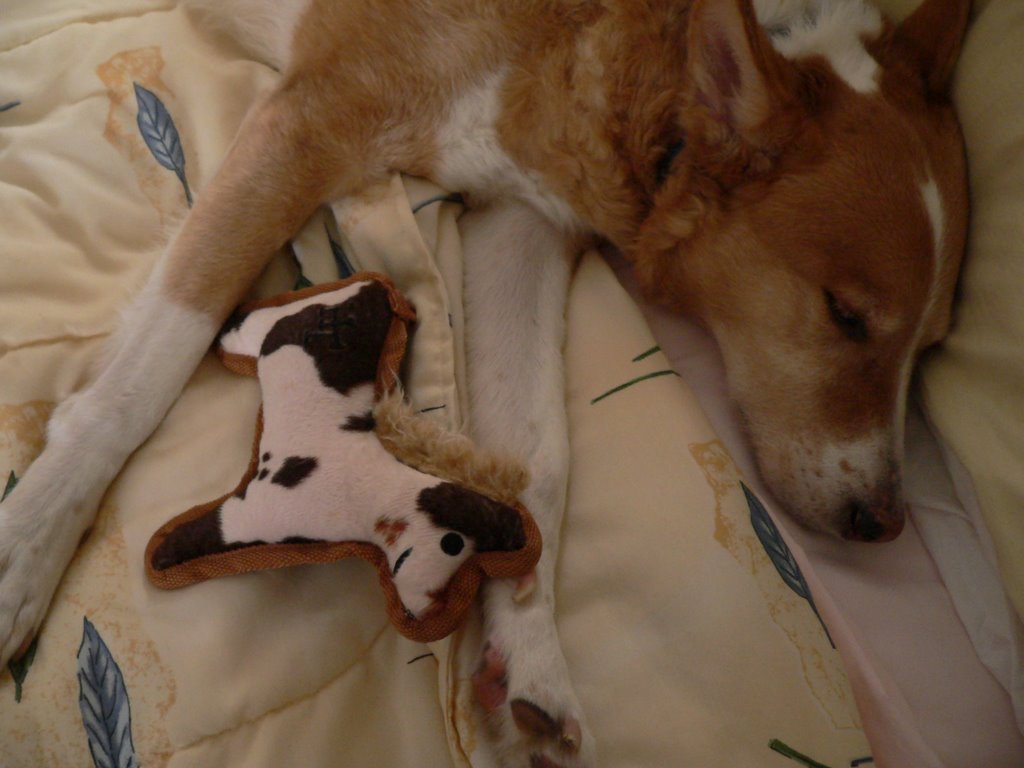
Okay, we have one spoiled doggy here. We took him up to Buffalo for a not-white Christmas with Hubby's family. I don't know if it was the lack of snow that got the dog depressed, or the fact that his hip hurts, which may be arthritis and may be something else, but all he wanted to do was sleep on Grandma's bed. Which he's not allowed to do, but we left on a day trip to Toronto, and the dog took liberties.
Here's a piece of Toronto, by the way, shot near the very diverse Kensington Market. I had never been there before and I absolutely loved it. Hubby says we can move there if another Bush gets elected in '08. Then we got caught in a bad traffic jam and we started to rethink that plan.


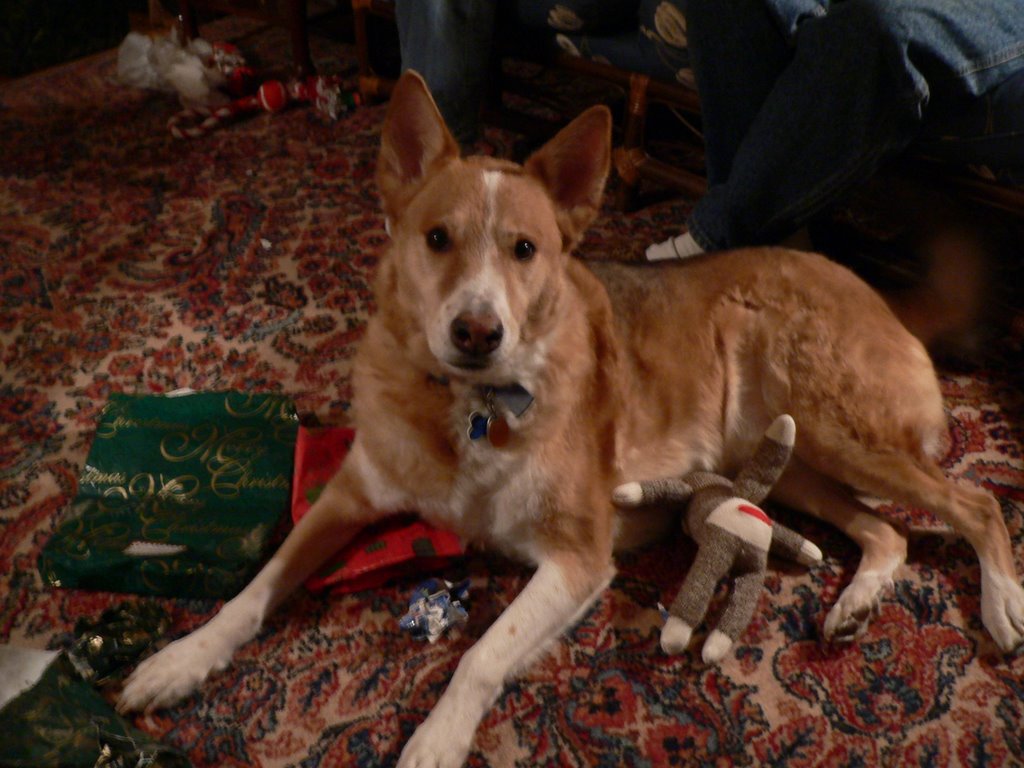
Christmas was quiet, except the present part, which got the dog wound up. I tried to tell him that Christmas was about the baby Jesus but he didn't get it. He likes opening gifts, ripping the paper. I wish we had video, it's pretty funny. Here he is in the joyful aftermath.
Saturday, December 16, 2006
The New Smokelong Quarterly is Live

Matt Bell did a great job guest editing this issue. I'm so stoked to be in the company of these rock stars. If you haven't discovered Nadine Darling yet, discover her. There are several contributions from the Michigan/Hobart posse, and even one from Stephen Elliott, who I want to believe is a distant relation of mine, one of the talented ones.
Friday, December 15, 2006
Interview in Until Monday--718 in the House!
Hi folks, sorry I haven't been posting much lately. I've been busy reading (Tennessee Williams), writing (fiction), and prepping for the holidays.
The incomparable poet and memoirist Cheryl Burke interviewed me for this interesting publication, Until Monday. It's a Brooklyn guide and more. Check it out! I'm gonna bookmark this site. They have good tips on places off the beaten path where I can go off my diet. Plus profiles on my fellow boroughites, and cool event info.
Hope you are staying sane, dry, and warm. My thoughts go out to my family in the Pacific Northwest, who have been unreachable in the power outage. I trust they are okay, they are hardy, smart, and are probably hunkering down to wait it out.
The incomparable poet and memoirist Cheryl Burke interviewed me for this interesting publication, Until Monday. It's a Brooklyn guide and more. Check it out! I'm gonna bookmark this site. They have good tips on places off the beaten path where I can go off my diet. Plus profiles on my fellow boroughites, and cool event info.
Hope you are staying sane, dry, and warm. My thoughts go out to my family in the Pacific Northwest, who have been unreachable in the power outage. I trust they are okay, they are hardy, smart, and are probably hunkering down to wait it out.
Saturday, December 02, 2006
Me With Comedians? I'll Give My Best Shot
I'm reading at PVC next Thursday, come on down! I've decided to leave the ukulele home and do straight poetry. I miss that. Stoked to be reading with friends Gloria and Hal. Thanks, Cheryl, for booking me!
Cheryl B. Presents:
PVC: The POETRY vs. COMEDY VARIETY SHOW
December 7th, 8PM
Galapagos Arts Space
70 North 6th Street, Brooklyn
L Train to Bedford Ave.
FREE
www.myspace.com/pvcshow
About the Show:PVC is neither an ordinary poetry slam nor a stand-up comedy show. The Poetry Vs. Comedy Variety Show is a battle of wits and rhymes where the stanzas and the stand-up collide. The show is monthly at Galapagos Arts Space in Williamsburg (70 N. 6th St). Produced by writer and literary series curator Cheryl B., PVC boasts a line-up of venerable poets and rising star comedians.
EMCEE: Carolyn Castiglia (Caroline's)
STARRING:
Comedians
Joe Dixon (NYC Comedian)
Lang Fisher (VH1's Best Night Ever Podcast)
Jenny Rubin (Oh My God)
Poets
Anne Elliott (Pindeldyboz)
Gloria (Kanipchen-fit)
Hal Sirowitz (NPR, MTV, PBS)
MUSICAL GUEST:
The Goddess Perlman (TLC, MTV, Metro Channel)
Cheryl B. Presents:
PVC: The POETRY vs. COMEDY VARIETY SHOW
December 7th, 8PM
Galapagos Arts Space
70 North 6th Street, Brooklyn
L Train to Bedford Ave.
FREE
www.myspace.com/pvcshow
About the Show:PVC is neither an ordinary poetry slam nor a stand-up comedy show. The Poetry Vs. Comedy Variety Show is a battle of wits and rhymes where the stanzas and the stand-up collide. The show is monthly at Galapagos Arts Space in Williamsburg (70 N. 6th St). Produced by writer and literary series curator Cheryl B., PVC boasts a line-up of venerable poets and rising star comedians.
EMCEE: Carolyn Castiglia (Caroline's)
STARRING:
Comedians
Joe Dixon (NYC Comedian)
Lang Fisher (VH1's Best Night Ever Podcast)
Jenny Rubin (Oh My God)
Poets
Anne Elliott (Pindeldyboz)
Gloria (Kanipchen-fit)
Hal Sirowitz (NPR, MTV, PBS)
MUSICAL GUEST:
The Goddess Perlman (TLC, MTV, Metro Channel)
Wednesday, November 29, 2006
Attrition
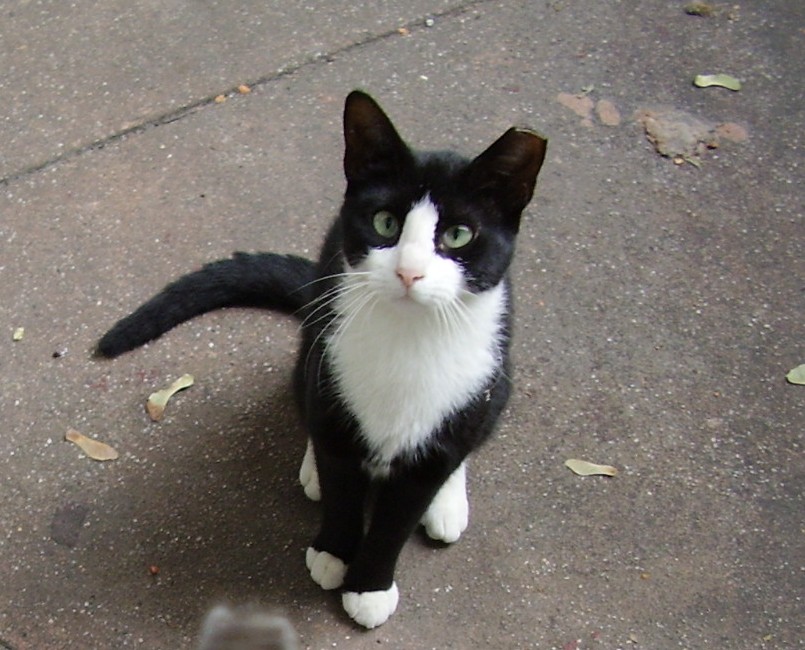
Sadly, our little Junior-girl has left us. We haven't found a body, but we haven't seen her since early October. So, we're facing facts. The odds are not with her, poor thing.
Junior came to us as a tiny, barely-weaned kitten in the summer of 2004. We named her Junior, thinking she was a boy. She made it through the winter, and come spring, we trapped her and got her neutered along with the rest of our little colony. We tried from the beginning to tame her, but only got her to allow petting while she was eating. Chances are very slim that she has found a human family, since her level of trust is quite low. There is a possibility she found another wild colony to live with--perhaps one of the two black-and-white colonies in our immediate vicinity--maybe even with her own blood relatives. We have no idea who her parents are, for sure. (Her cross-eyes do indicate that Angus might be her father. Though I've always thought of Angus as a gay cat, you never know.)
Urban feral cats rarely move outside a one-block radius. Experts advise never to try to move them, they will only seek their original home, risking life and limb to get there. It is much more likely that she got trapped somewhere (they can live for three weeks without water or food, I'm told), poisoned (possibly intentionally), hit by a car, or died of an illness.
Natural attrition is the goal of TNR, but it's still sad to see them disappear. Godspeed, little Junior, wherever you are.
Sunday, November 12, 2006
For the Love of the Loose Cannon
I was biased going into Jim Tomlinson's short story collection, THINGS KEPT, THINGS LEFT BEHIND. Glad to report it met my high expectations.
The collection has eleven character-driven stories, most set in rural Kentucky. One of the book's characters, an old man on his deathbed, tells his nurse: "My son's a writer...he can imagine anything, make it up from nothing, and care like it was real." A good characterization of Tomlinson's work. Care is evident on every page--care for language, care for people, and not just fictional characters, but the very real aspects of ourselves that they represent.
What struck me most is Tomlinson's real sense of loose-cannon personalities: the stubborn elderly mother, the brother prone to violence, the businessman who suddenly drops everything, the young idealist who burns his draft card. The cranky, the war-broken, the adulterous--and the people who live with them--these are Tomlinson's cast, each portrayed with empathy and grace. The grace comes, I believe, from his precision. The prose is economical, but not sparse. The diction is regional, but never parody. Exasperation is always a product of familiarity, which goes hand in hand with love.
This juxtaposition of gentle telling with not-gentle characters is the key to the success of these stories. Tomlinson loves these characters the way flawed people love themselves, the way family members quarrel and reconcile. They are not rural eccentrics designed to entertain the rest of us with their novelty. They are essential beings, whose choices carry gravity.
This love of character is what makes realist fiction satisfying for me, when it is done well. I don't need neat endings or dramatic "arcs" or all that crap that short story people fetishize. What I need is to know that people are loved, even the difficult ones. And Tomlinson is one writer who understands why and how this love is a craft issue.
Catching Up
Sorry, I haven't been posting. Believe it or not, it's because I've been writing. I know, blogging is writing, but it ain't the same thing. I've been working on my new novel, and just finished draft one of section one! So, I'm five chapters / 20,000 words / 71 pages in. Feels like a real commitment.
As promised, here is a brief history of our holiday cards. (I even got Hubby's permission to post them here.) Usually they have messages like "Peace on Earth." Apologize for the dust on the scanner.
Here's 2002, our first year in the new old house. Opie is in my arms, and fat Boo is in hubby's. Wilbur is very excited.

Here's 2003, when I think we had a freak snowstorm in November. It was cruel not to let Wilbur out in the snow. He loves snow, and besides, he got all dressed up.
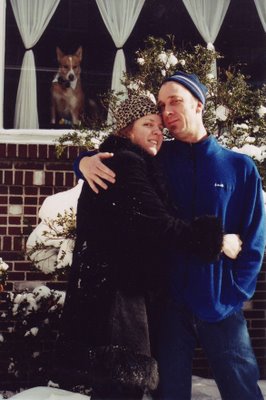
Here's 2004, the peak of our household count. You can see Angus, in front of Opie, is missing half of his ass. When we brought him in he basically had to have a full body shave because of abscess. He's all better now! Also pictured is Egypt, who was a holiday guest. There's catnip in the bowls, in case you want the secret.
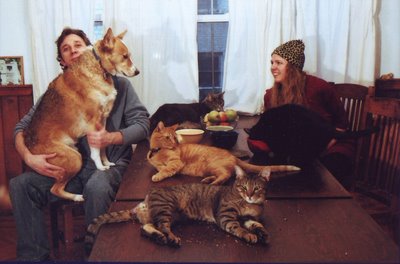
And finally, 2005. It's a bittersweet picture, because Opie is in the urn on the table. Still, Angus is hard not to laugh at. He grew up on the streets and does not like to wear "outfits."

We're working on 2006 now. Nothing good yet, but we still have time. In the meantime, I got this cute shot of our newest family member, Ava:

And this one can be Willie's album cover. When he becomes a folksinger.

As promised, here is a brief history of our holiday cards. (I even got Hubby's permission to post them here.) Usually they have messages like "Peace on Earth." Apologize for the dust on the scanner.
Here's 2002, our first year in the new old house. Opie is in my arms, and fat Boo is in hubby's. Wilbur is very excited.

Here's 2003, when I think we had a freak snowstorm in November. It was cruel not to let Wilbur out in the snow. He loves snow, and besides, he got all dressed up.
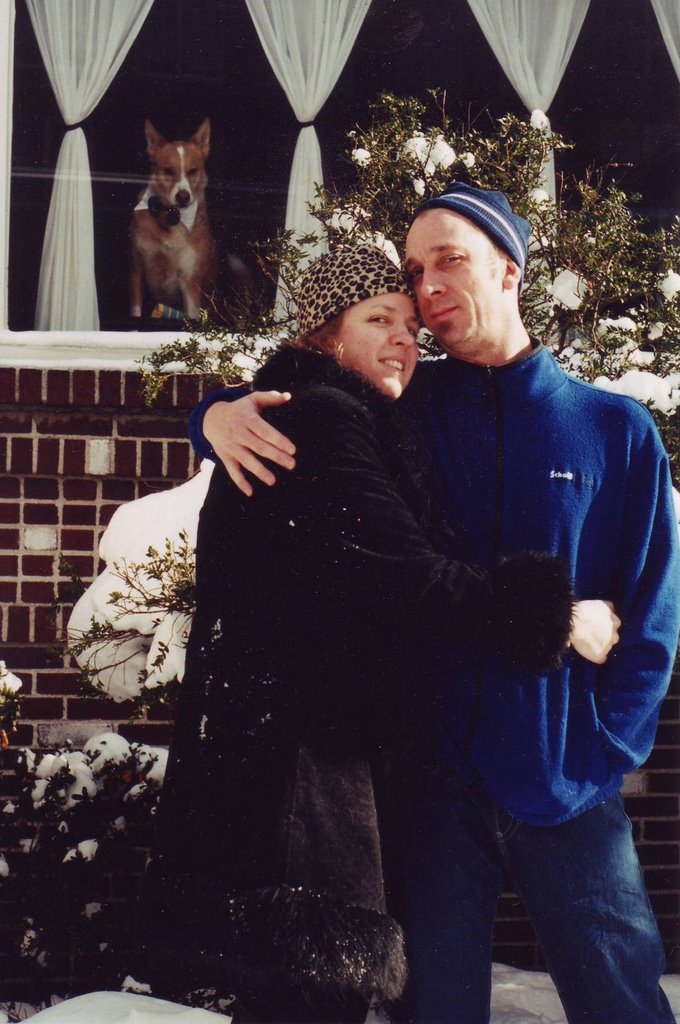
Here's 2004, the peak of our household count. You can see Angus, in front of Opie, is missing half of his ass. When we brought him in he basically had to have a full body shave because of abscess. He's all better now! Also pictured is Egypt, who was a holiday guest. There's catnip in the bowls, in case you want the secret.
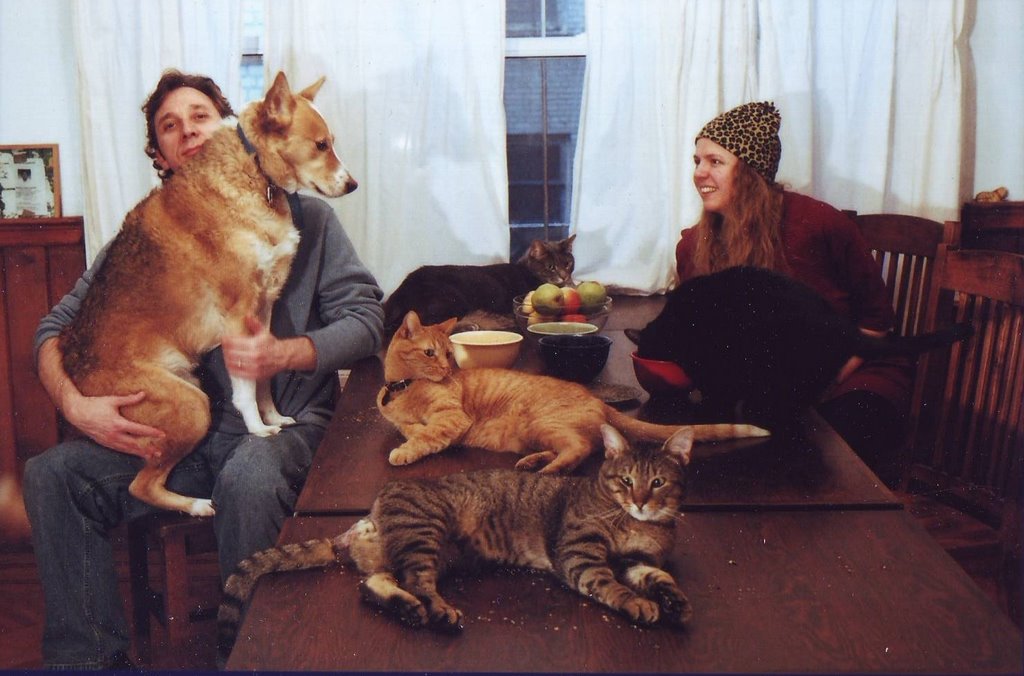
And finally, 2005. It's a bittersweet picture, because Opie is in the urn on the table. Still, Angus is hard not to laugh at. He grew up on the streets and does not like to wear "outfits."

We're working on 2006 now. Nothing good yet, but we still have time. In the meantime, I got this cute shot of our newest family member, Ava:
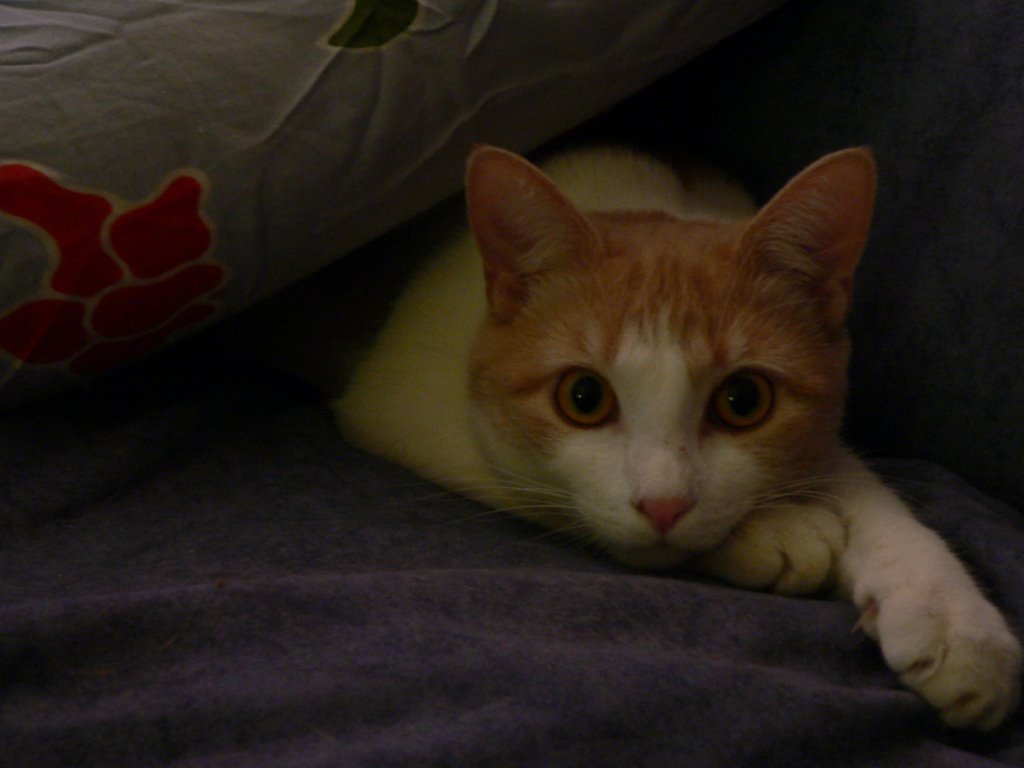
And this one can be Willie's album cover. When he becomes a folksinger.

Friday, November 03, 2006
Toy or Tool? Or Both?
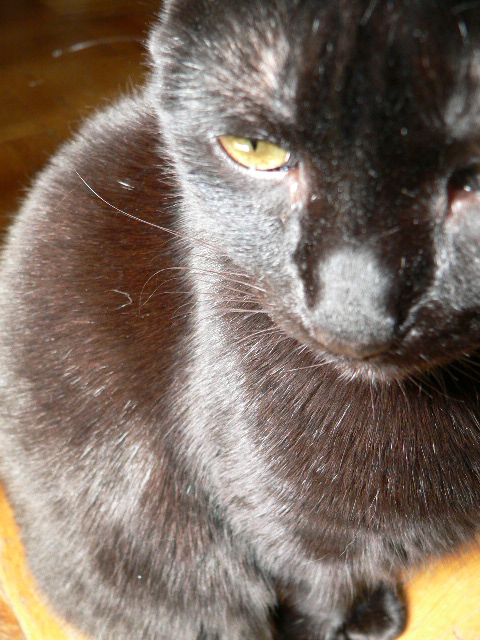
Confession time, I have a new bourgeois toy. Sweet Hubby got me a new camera for my 40th. I'm just starting to figure out what it can do. I'm starting with portraiture. Above is Queen Egypt Holwerda-Williams, who visits us for about a month every year while her folks go to Holland. And boy, is she in charge.
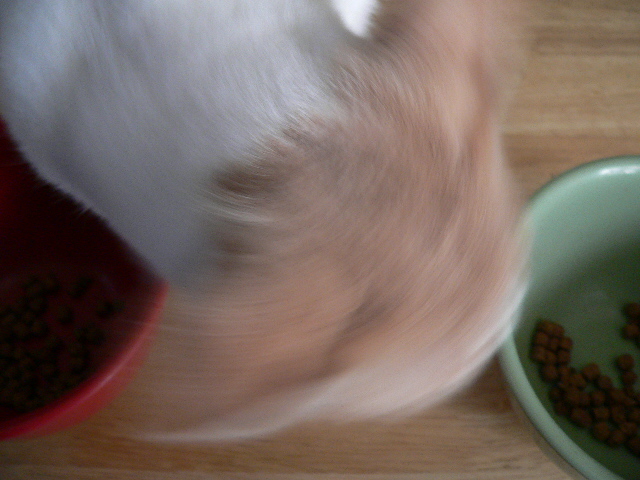
The new camera lets me capture motion. Here's Ava trying to decide which food bowl is better.
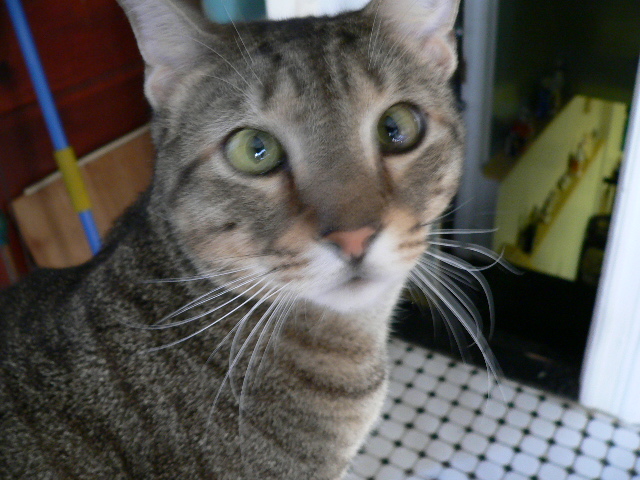
I'm still getting the hang of it. The lens gets some good color. Here's our little crosseyed Angus.
What I like is now I have more control, I just need to learn how to use it. I can manual focus, and turn the flash off, to get natural light. Like the gorgeous brown eyes of Wilbur, now free of that green crap I used to get whenever he looked in the lens.

So first project is to make a good Christmas card. We've done family portraits for the past three years. Maybe I'll try to digitize them and share our little history, with its changing personae.
Thursday, November 02, 2006
Dia De Los Muertos
My mother had the good sense of humor to die on November 2nd, Day of the Dead. So I take the day to remember her, and as the years pass, the memories change. The first few years I had vivid memories of her last days in the hospital, the details of the room, the crowd of people gathered, bonding with each other over our shared love of the woman in the bed.
This year, without any forcing, my memories are of her as a vibrant not-sick person. She was a proj-aholic too. She put muslin banners on our kitchen walls in Seattle, to pin up our art projects for proud display. She was a constant cheerleader for the creative lives of the family members--my father's music, my writing and plastic arts, my brother's theater. And she was wildly creative herself.
For her, creativity was her way of playing, reconnecting with her own innocence, fostering mental health. If she had aspirations to become a professional artist, she didn't push them. For her, it was the joy of the project itself. Knitting, of course, she usually had a sweater or afghan in the works. Drawing--she was a gifted cartoonist, too. Gardening--her roses were incredible. And music. She played organ, and was one of those musicologists who could identify a composer by hearing just a few bars. She had her favorites, particularly "Mr. Brahms," as she called him. She sang, for pleasure, in the car and while working in the kitchen, and in choirs. She was an alto, like me.
She was also messy, like me. Hurricane Jane was one of her nicknames. She used to say, "if you want creative children, you have to be tolerant of messes." One of her mottoes. Another: "if you want to be an artist, you need to learn a trade." So I can credit her with a few things--my messy studio, my tolerance of day-job compromises, my ability to make a living but not forget the art, my intense craving for creative endeavors of all kinds.
She was a lover of cats. We couldn't have cats in the house because of allergies, but she became best friends with an outdoor cat when we lived in California, who stuck with her through her illness. During some of the rough spots, she would lie on the couch with a towel across her chest, and Tillie, a big white fluffball, would be allowed inside to sleep on top of her. Tillie was a good kitty, she knew not to wander the house. She knew what her friend Jane needed. Maybe Tillie needed it too.
Cats symbolized something for Mom. A certain independence, a kind of childlike devilishness. Cats are very busy creatures. They also like a good hug every now and then. Mom was the same way.
I miss her terribly. Her legacy is obvious, it's all around me, the knitting book next to my elbow, the graph paper and pens under my laptop right now, the stack of papers behind that, and the joy I find in all these things. So if I can't have her nearby, I can at least know her ideas have shaped my life for the better. The things she taught me are among the things that keep me sane.
Thanks, Mom, I'm turning out like you and it's not so bad. I wish you could meet my beautiful husband, and my family of four-legged furry ones. I tell them about you, every chance I get.
This year, without any forcing, my memories are of her as a vibrant not-sick person. She was a proj-aholic too. She put muslin banners on our kitchen walls in Seattle, to pin up our art projects for proud display. She was a constant cheerleader for the creative lives of the family members--my father's music, my writing and plastic arts, my brother's theater. And she was wildly creative herself.
For her, creativity was her way of playing, reconnecting with her own innocence, fostering mental health. If she had aspirations to become a professional artist, she didn't push them. For her, it was the joy of the project itself. Knitting, of course, she usually had a sweater or afghan in the works. Drawing--she was a gifted cartoonist, too. Gardening--her roses were incredible. And music. She played organ, and was one of those musicologists who could identify a composer by hearing just a few bars. She had her favorites, particularly "Mr. Brahms," as she called him. She sang, for pleasure, in the car and while working in the kitchen, and in choirs. She was an alto, like me.
She was also messy, like me. Hurricane Jane was one of her nicknames. She used to say, "if you want creative children, you have to be tolerant of messes." One of her mottoes. Another: "if you want to be an artist, you need to learn a trade." So I can credit her with a few things--my messy studio, my tolerance of day-job compromises, my ability to make a living but not forget the art, my intense craving for creative endeavors of all kinds.
She was a lover of cats. We couldn't have cats in the house because of allergies, but she became best friends with an outdoor cat when we lived in California, who stuck with her through her illness. During some of the rough spots, she would lie on the couch with a towel across her chest, and Tillie, a big white fluffball, would be allowed inside to sleep on top of her. Tillie was a good kitty, she knew not to wander the house. She knew what her friend Jane needed. Maybe Tillie needed it too.
Cats symbolized something for Mom. A certain independence, a kind of childlike devilishness. Cats are very busy creatures. They also like a good hug every now and then. Mom was the same way.
I miss her terribly. Her legacy is obvious, it's all around me, the knitting book next to my elbow, the graph paper and pens under my laptop right now, the stack of papers behind that, and the joy I find in all these things. So if I can't have her nearby, I can at least know her ideas have shaped my life for the better. The things she taught me are among the things that keep me sane.
Thanks, Mom, I'm turning out like you and it's not so bad. I wish you could meet my beautiful husband, and my family of four-legged furry ones. I tell them about you, every chance I get.
Friday, October 27, 2006
Friday Night, Let's Dance!
My esteemed Russian colleague reminds me that her people really know how to dance. She shared with me these videos, which I'll share with you.
Here's how the pros do it:
And not to be outdone, here's how average citizens do it:
Let's roll back the rug and join 'em! Wilbur, start the barking now!
Here's how the pros do it:
And not to be outdone, here's how average citizens do it:
Let's roll back the rug and join 'em! Wilbur, start the barking now!
Subscribe to:
Posts (Atom)